Understanding antonyms is a great way to improve your English vocabulary and communicate more clearly. If you know the meaning of generous, learning its opposite words can help you describe different personalities, behaviors, and attitudes more accurately.
The word generous describes someone who is willing to give money, time, help, or other things to others without expecting much in return. A generous person often shows kindness, care, and a willingness to share.
However, not everyone behaves generously. Some people may be selfish, greedy, stingy, or unwilling to share what they have. These words express different meanings opposite to generous.
In this guide, you will discover more than 50 antonyms for generous, along with their meanings and example sentences. You will also learn how to use these opposite words in everyday conversations, professional writing, and different situations.
What Does Generous Mean?
Generous means being willing to give, share, or help others freely. It describes someone who thinks about other people’s needs and does not hesitate to offer support.
Generosity can involve money, food, gifts, time, knowledge, or emotional support.
Examples:
- She is generous with her time and always helps her friends.
- My uncle is generous and often donates to charity.
- The company made a generous donation to the local school.
- He received a generous gift from his family.
The opposite of generous describes someone who is unwilling to share, gives very little, or thinks mainly about their own interests.
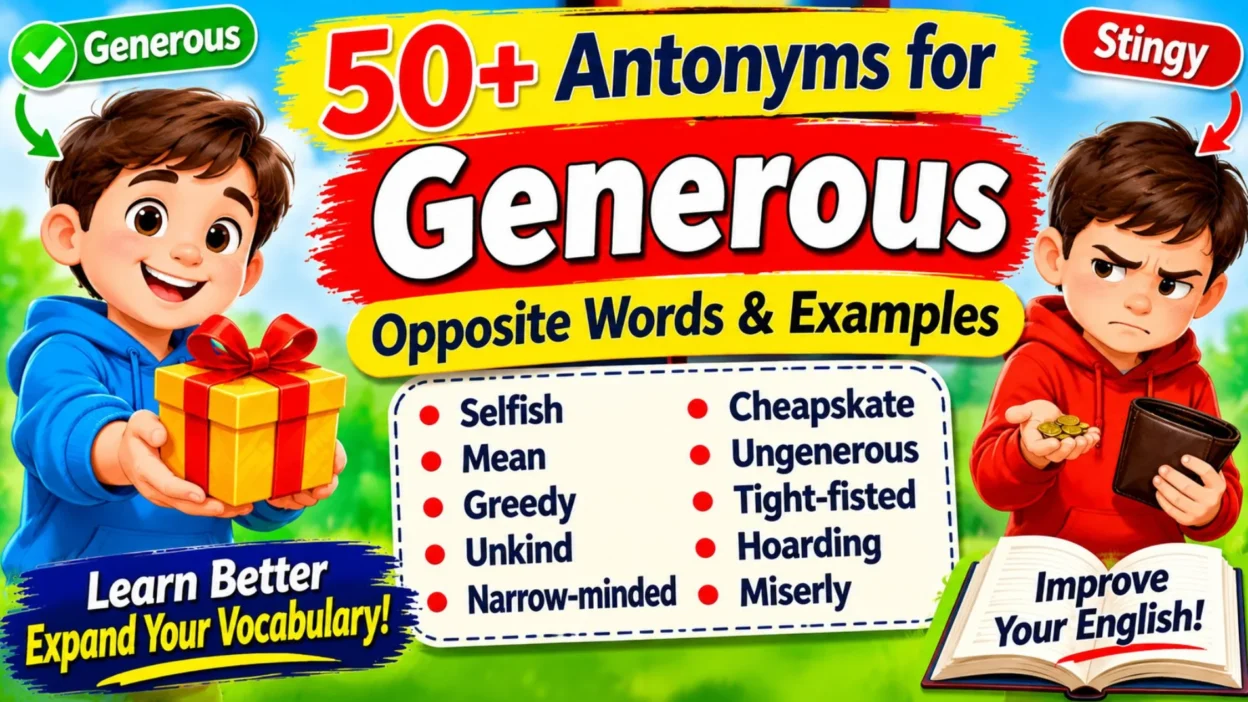
50+ Antonyms for Generous
Here are more than 50 opposite words for generous, with simple meanings and example sentences.
1. Selfish
Meaning: Caring mainly about yourself rather than other people.
Example: It is selfish to keep everything for yourself when others need help.
2. Greedy
Meaning: Wanting more money, possessions, or benefits than you need.
Example: The greedy businessman wanted to earn more money without helping his employees.
3. Stingy
Meaning: Unwilling to spend money or share things with others.
Example: He is too stingy to buy gifts for his friends.
4. Miserly
Meaning: Extremely unwilling to spend money.
Example: The miserly owner refused to pay for necessary repairs.
5. Self-centered
Meaning: Thinking mainly about your own needs and interests.
Example: His self-centered behavior upset everyone at the meeting.
6. Mean
Meaning: Unkind or unwilling to share with others.
Example: It was mean of him to refuse to help his younger brother.
7. Ungenerous
Meaning: Not willing to give, share, or help freely.
Example: Her ungenerous response disappointed the team.
8. Tightfisted
Meaning: Very unwilling to spend or give money.
Example: The tightfisted manager avoided spending money on employee benefits.
9. Avaricious
Meaning: Having an extreme desire for wealth or possessions.
Example: The avaricious businessman cared more about profit than people.
10. Covetous
Meaning: Strongly wanting something that belongs to someone else.
Example: His covetous attitude created unnecessary competition.
11. Possessive
Meaning: Unwilling to share or let others use something you own.
Example: The child became possessive of his favorite toys.
12. Inconsiderate
Meaning: Not thinking about other people’s feelings or needs.
Example: It was inconsiderate of him to ignore their requests.
13. Unkind
Meaning: Not showing kindness or care toward others.
Example: Her unkind words hurt his feelings.
14. Self-serving
Meaning: Acting mainly to benefit yourself.
Example: His self-serving decision affected the entire department.
15. Grasping
Meaning: Always wanting more money or possessions.
Example: The grasping investor wanted to control every business opportunity.
16. Cheap
Meaning: Unwilling to spend money, even when necessary.
Example: He was too cheap to replace his damaged shoes.
17. Parsimonious
Meaning: Extremely careful about spending money.
Example: The parsimonious employer refused to provide basic office supplies.
18. Closefisted
Meaning: Unwilling to spend or give money.
Example: His closefisted nature made group activities difficult.
19. Narrow-minded
Meaning: Unwilling to consider other people’s opinions or needs.
Example: A narrow-minded attitude can prevent people from understanding others.
20. Uncharitable
Meaning: Not willing to help others or show kindness.
Example: His uncharitable comments made the situation worse.
21. Unsharing
Meaning: Not willing to share things with others.
Example: The unsharing child did not allow anyone to use his toys.
22. Unsympathetic
Meaning: Not showing understanding or concern for someone else’s problems.
Example: The manager was unsympathetic toward the employee’s difficulties.
23. Heartless
Meaning: Showing no kindness or compassion.
Example: It was heartless to ignore someone who needed urgent help.
24. Cold-hearted
Meaning: Lacking warmth, kindness, or sympathy.
Example: His cold-hearted response surprised everyone.
25. Unhelpful
Meaning: Not offering support or assistance when needed.
Example: The staff member was unhelpful during the complaint process.
26. Inhospitable
Meaning: Not welcoming or friendly toward guests.
Example: The visitors received an inhospitable welcome.
27. Uncharitable
Meaning: Unwilling to show kindness or generosity.
Example: Her uncharitable attitude damaged their friendship.
28. Materialistic
Meaning: Giving too much importance to money and possessions.
Example: His materialistic lifestyle left little room for helping others.
29. Selfish-minded
Meaning: Focused mainly on personal benefits rather than others.
Example: A selfish-minded person may ignore the needs of friends.
30. Ungiving
Meaning: Not willing to give or share.
Example: His ungiving attitude made cooperation difficult.
31. Uncooperative
Meaning: Unwilling to work with or assist others.
Example: The uncooperative employee refused to support the team.
32. Unkindhearted
Meaning: Not naturally showing kindness or compassion.
Example: His unkindhearted behavior disappointed his neighbors.
33. Self-absorbed
Meaning: So focused on yourself that you pay little attention to others.
Example: She considered his self-absorbed behavior disrespectful.
34. Unsupportive
Meaning: Not giving encouragement, help, or assistance.
Example: His family felt he was unsupportive during a difficult time.
35. Hard-hearted
Meaning: Not easily affected by other people’s suffering.
Example: The hard-hearted landlord refused to listen to their concerns.
36. Ungracious
Meaning: Not showing politeness, kindness, or appreciation.
Example: His ungracious response disappointed the guests.
37. Unfriendly
Meaning: Not kind, warm, or welcoming.
Example: The unfriendly shopkeeper refused to answer simple questions.
38. Uncompassionate
Meaning: Not showing concern for the suffering of others.
Example: An uncompassionate response can make a difficult situation worse.
39. Self-interested
Meaning: Mainly concerned with personal advantage.
Example: His self-interested decision ignored the team’s needs.
40. Profit-driven
Meaning: Mainly focused on making money rather than helping others.
Example: The profit-driven company reduced its community support program.
41. Inhumane
Meaning: Showing a lack of kindness or concern for human suffering.
Example: Treating workers unfairly is inhumane.
42. Uncharitable-minded
Meaning: Having an unwilling attitude toward helping or supporting others.
Example: His uncharitable-minded approach created tension.
43. Egoistic
Meaning: Excessively focused on personal interests and importance.
Example: His egoistic behavior made teamwork difficult.
44. Egocentric
Meaning: Believing that your own feelings and interests are more important than others’.
Example: An egocentric person may struggle to understand different viewpoints.
45. Unsocial
Meaning: Not interested in social interaction or spending time with others.
Example: He became unsocial after moving to a new city.
46. Exploitative
Meaning: Taking unfair advantage of other people for personal benefit.
Example: The exploitative employer refused to pay workers fairly.
47. Uncharitable in spirit
Meaning: Lacking a willingness to show kindness or understanding.
Example: His uncharitable spirit affected his relationships.
48. Ungiving-hearted
Meaning: Unwilling to give help, support, or kindness.
Example: An ungiving-hearted attitude can create distance between friends.
49. Selfish-hearted
Meaning: Showing concern mainly for personal needs and desires.
Example: His selfish-hearted actions disappointed his family.
50. Hoarding
Meaning: Keeping too many things instead of sharing or giving them away.
Example: Hoarding useful supplies can prevent others from getting what they need.
51. Acquisitive
Meaning: Having a strong desire to acquire money, possessions, or property.
Example: His acquisitive nature made him focus constantly on gaining wealth.
Best Antonyms for Generous in Different Situations
Not every opposite word works in every sentence. Some words describe a person’s attitude toward money, while others describe their treatment of people.
Here is a quick comparison to help you choose the right antonym.
SituationBest AntonymSomeone who refuses to shareSelfishSomeone who avoids spending moneyStingySomeone who wants more wealthGreedySomeone who spends very littleMiserlySomeone who ignores others’ feelingsInconsiderateSomeone who lacks kindnessUnkindSomeone who thinks only about themselvesSelf-centeredSomeone who refuses to helpUngenerousSomeone who lacks compassionHeartlessSomeone who wants personal benefitsSelf-servingSomeone who dislikes spending moneyTightfistedSomeone who takes advantage of othersExploitative
Antonyms for Generous in Different Parts of Speech
Understanding the grammatical form of a word can help you use antonyms correctly.
1. Adjective Antonyms
These words describe a person’s character, attitude, or behavior.
- Selfish
- Greedy
- Stingy
- Miserly
- Ungenerous
- Inconsiderate
- Unkind
- Self-centered
- Tightfisted
- Uncharitable
Example: He is a selfish person who rarely shares with others.
2. Noun Antonyms
These nouns describe qualities or behaviors opposite to generosity.
- Selfishness
- Greed
- Stinginess
- Miserliness
- Self-centeredness
- Avarice
- Self-interest
- Inconsideration
Example: His selfishness affected his relationship with his friends.
3. Related Opposite Expressions
Sometimes, a phrase communicates the opposite of generous more naturally than a single word.
- Unwilling to share
- Reluctant to give
- Focused on personal gain
- Lacking compassion
- Not willing to help
- Keeping everything for yourself
Example: He was unwilling to share his resources with the team.
Generous vs. Selfish: What’s the Difference?
Generous and selfish describe opposite approaches to treating other people.
A generous person is willing to share resources, offer support, and help others. A selfish person usually focuses on personal needs and may ignore the needs of others.
Here is a simple comparison:
GenerousSelfishShares with othersKeeps things for themselvesOffers helpAvoids helpingShows kindnessMay ignore others’ needsGives freelyReluctant to giveThinks about othersFocuses on personal interestsSupports peoplePrioritizes personal benefits
Example of generous behavior: Sarah shared her lunch with a classmate who had forgotten to bring food.
Example of selfish behavior: Mark refused to share his supplies even when his classmates needed them.
How to Use Antonyms for Generous in Sentences
The best way to learn opposite words is to practice using them in everyday sentences.
Here are some examples:
- Generous: My neighbor is generous with his time. Opposite: My neighbor is selfish with his time.
- Generous: She made a generous donation. Opposite: He was stingy with his money.
- Generous: The company offered generous benefits. Opposite: The company provided limited benefits.
- Generous: He is always willing to help others. Opposite: He is unwilling to help others.
- Generous: They welcomed their guests warmly. Opposite: They gave their guests an unfriendly welcome.
- Generous: She shared her knowledge freely. Opposite: He was unwilling to share his knowledge.
- Generous: The manager supported the employees. Opposite: The manager was unsupportive of the employees.
- Generous: He donated money to charity. Opposite: He kept all his money for himself.
Frequently Asked Questions
1. What is the opposite of generous?
The most common opposite of generous is selfish. Other antonyms include greedy, stingy, miserly, ungenerous, and tightfisted.
2. What is another word for not generous?
Ungenerous is a direct alternative. You can also use stingy, selfish, miserly, or tightfisted, depending on the context.
3. What is a strong antonym for generous?
Greedy, miserly, and avaricious are strong antonyms. These words describe people who strongly prioritize personal wealth or possessions.
4. What is the opposite of generous with money?
Stingy, miserly, tightfisted, parsimonious, and cheap are common alternatives when describing someone who does not like spending or sharing money.
5. What is the opposite of a generous person?
A selfish person is often considered the opposite of a generous person. A selfish person usually puts personal interests before the needs of others.
6. Is selfish the same as greedy?
No. Selfish means mainly caring about your own interests, while greedy means wanting more money, possessions, or benefits than necessary. Both words can describe behavior opposite to generosity.
7. What is the opposite of generous in one word?
Selfish is the simplest and most commonly used one-word antonym for generous.
8. What is the difference between stingy and miserly?
Both words describe someone who dislikes spending money. However, miserly often suggests an extreme unwillingness to spend, while stingy is more commonly used in everyday conversations.
9. Can ungenerous be used instead of selfish?
Yes. Ungenerous describes someone who is unwilling to give or share. Selfish focuses more broadly on putting personal interests first.
10. What are some positive words opposite to generous?
There are no perfect positive antonyms for generous because generosity is generally a positive quality. However, words such as independent, self-reliant, and reserved may describe specific behaviors without necessarily suggesting an unkind personality.
Conclusion
Learning antonyms for generous can help you understand different personalities and express ideas more accurately. Words such as selfish, greedy, stingy, miserly, and ungenerous are common opposites, but each has a slightly different meaning.
For example, selfish describes someone who mainly considers personal needs, while stingy describes someone who is unwilling to share money or possessions. Choosing the correct word depends on the situation you want to describe.
Practice these antonyms in your daily conversations and writing to build a stronger English vocabulary. The more you understand their meanings, the easier it becomes to choose the right word.

Shehroz Ali is a digital content creator and the founder of SynonymVoro. He is passionate about vocabulary, language, writing, and creating useful online resources that make learning simple and accessible. Through SynonymVoro, he aims to help readers discover better words, improve their vocabulary, and communicate with greater clarity.