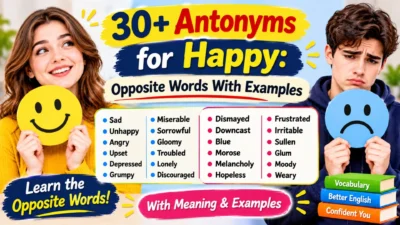
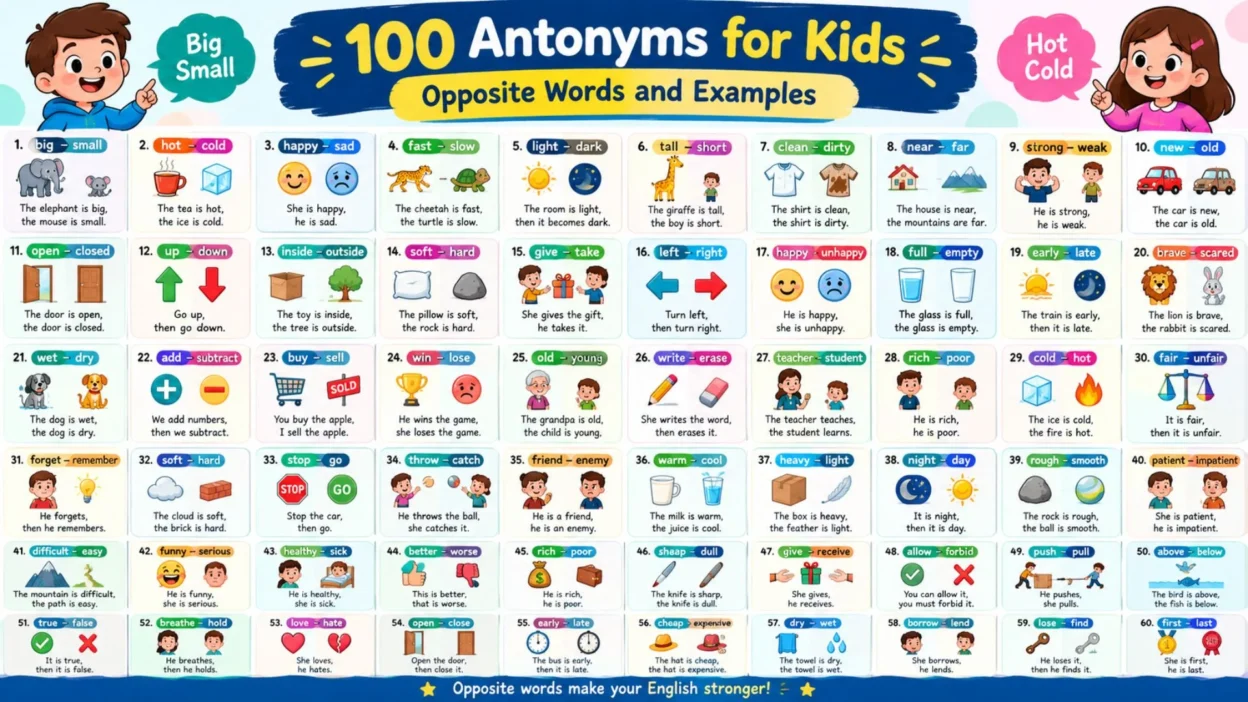
Learning antonyms is a simple and fun way to improve English vocabulary. Antonyms are words that have opposite or contrasting meanings. For example, hot and cold, big and small, and happy and sad are common antonym pairs.
Children can learn antonyms to improve their reading, writing, speaking, and understanding of English. These words also help students describe people, objects, feelings, and everyday situations more clearly.
In this guide, you will discover 100 common antonyms for kids, along with simple examples and meanings. You will also learn different types of opposite words and find easy activities to practice them at home or in the classroom.
What Are Antonyms?
Antonyms are words with opposite or contrasting meanings. They help us understand differences between things, actions, and feelings.
For example:
- Big — Small: A big box is larger than a small box.
- Happy — Sad: A happy person feels joy, while a sad person feels unhappy.
- Fast — Slow: A fast car moves quickly, while a slow car moves at a lower speed.
- Open — Closed: An open door allows people to enter, while a closed door does not.
Learning opposite words makes it easier for children to understand sentences and express their thoughts.
Types of Antonyms
Not all antonyms work in exactly the same way. Understanding these basic types helps children learn how opposite words relate to each other.
1. Gradable Antonyms
Gradable antonyms describe opposite ends of a scale. There may be several possibilities between the two words.
Examples include:
- Hot and cold
- Big and small
- Fast and slow
- Happy and sad
- Strong and weak
For instance, water can be warm, cool, hot, or cold. It does not have to be at either extreme.
2. Complementary Antonyms
Complementary antonyms describe two contrasting states where one generally excludes the other in the relevant context.
Examples include:
- Alive and dead
- True and false
- Present and absent
- Pass and fail
For example, a student may be marked present or absent for a particular class session.
3. Relational Antonyms
Relational antonyms describe opposite sides of the same relationship.
Examples include:
- Buy and sell
- Give and receive
- Teacher and student
- Parent and child
For example, when one person sells an item, another person may buy it.
4. Reversive Antonyms
Reversive antonyms describe actions that reverse or undo another action.
Examples include:
- Lock and unlock
- Tie and untie
- Connect and disconnect
- Enter and exit
For example, you lock a door to secure it and unlock it when you need to open it.
Why Are Antonyms Important for Kids?
Learning antonyms provides several benefits for children who are developing their English skills.
1. Builds vocabulary: Children learn new words and understand how their meanings contrast.
2. Improves reading comprehension: Recognizing opposite words helps students understand descriptions and comparisons in stories.
3. Strengthens writing skills: Antonyms help children describe differences clearly. For example, “The room was quiet, but the playground was noisy.”
4. Develops communication: Knowing words such as happy, sad, calm, and nervous helps children explain their feelings.
5. Supports schoolwork: Antonyms frequently appear in vocabulary exercises, spelling activities, reading lessons, and language tests.
Fun Activities to Practice Antonyms
Children can practice opposite words through simple games at home or in school.
Match the Opposite Words
Write one word on each card and its antonym on another card. Mix the cards and ask children to find the matching pairs.
For example:
- Hot — Cold
- Open — Closed
- Fast — Slow
- Happy — Sad
- Big — Small
This activity encourages children to recognize word relationships.
Fill in the Missing Antonym
Complete each sentence with the correct opposite word.
- The elephant is big, but the mouse is _____.
- Ice is cold, but soup can be _____.
- The turtle is slow, but the rabbit is _____.
- The room is dark, but the garden is _____.
- The glass is full, but the bottle is _____.
- The door is open, but the window is _____.
- The boy is happy, but the girl is _____.
- The road is wide, but the path is _____.
- The bag is heavy, but the box is _____.
- The question is easy, but the puzzle is _____.
Answers: 1. Small, 2. Hot, 3. Fast, 4. Light, 5. Empty, 6. Closed, 7. Sad, 8. Narrow, 9. Light, 10. Difficult.
Opposite Word Challenge
Choose a common word and ask children to say its opposite as quickly as possible.
For example:
- Teacher: Up
- Student: Down
- Teacher: Young
- Student: Old
- Teacher: Give
- Student: Take
You can make the game more challenging by using action words and less familiar vocabulary.
Draw and Compare
Ask children to draw opposite objects, such as a big house and a small house, a tall tree and a short tree, or a happy face and a sad face.
Then ask them to write a sentence describing each picture. This activity combines vocabulary practice with drawing and writing.
Frequently Asked Questions About Antonyms for Kids
What are antonyms in simple words?
Antonyms are words that have opposite or contrasting meanings. For example, hot and cold, up and down, and happy and sad are antonyms.
What are five examples of antonyms?
Five common examples are big–small, fast–slow, happy–sad, hot–cold, and open–closed.
What is the difference between synonyms and antonyms?
Synonyms are words with similar meanings, while antonyms have opposite or contrasting meanings. For example, happy and joyful are synonyms, whereas happy and sad are antonyms.
Why should children learn antonyms?
Children learn antonyms to expand their vocabulary, understand reading passages, write clearer sentences, and communicate more effectively.
How can I teach antonyms to a beginner?
Start with familiar pairs such as big–small, hot–cold, and up–down. Use pictures, objects, matching cards, and short sentences to make learning easier.
Can a word have more than one antonym?
Yes. The appropriate antonym can depend on the word’s meaning and context. For example, “light” can mean the opposite of “dark” when discussing brightness or the opposite of “heavy” when discussing weight.
Conclusion
Antonyms are an important part of English vocabulary because they help us understand contrasts and describe the world more clearly. From simple pairs such as big and small to more advanced pairs such as expand and contract, opposite words are useful in everyday conversations, school assignments, and reading activities.
Children can learn antonyms more easily by practicing with example sentences, word games, matching activities, and pictures. Start with a few familiar pairs each day, then gradually introduce more challenging vocabulary.
Keep exploring SynonymVoro.com for more English vocabulary guides, including synonyms, antonyms, word meanings, and practical language-learning tips.

Shehroz Ali is a digital content creator and the founder of SynonymVoro. He is passionate about vocabulary, language, writing, and creating useful online resources that make learning simple and accessible. Through SynonymVoro, he aims to help readers discover better words, improve their vocabulary, and communicate with greater clarity.