Finding the right words can make your writing clearer, more interesting, and more effective. However, using the same words repeatedly can make sentences sound boring. A synonym thesaurus helps you discover alternative words that express similar meanings.
Whether you are writing an essay, preparing a professional email, creating website content, or improving your English vocabulary, a thesaurus can be a useful resource. It gives you different word choices and helps you understand how language works.
In this guide, you will learn what a synonym thesaurus is, how it works, why it is useful, and how to choose the right synonym for different situations.
What Is a Synonym Thesaurus?
A synonym thesaurus is a reference tool that helps you find words with similar or related meanings. It provides alternative words that you can use instead of a particular word.
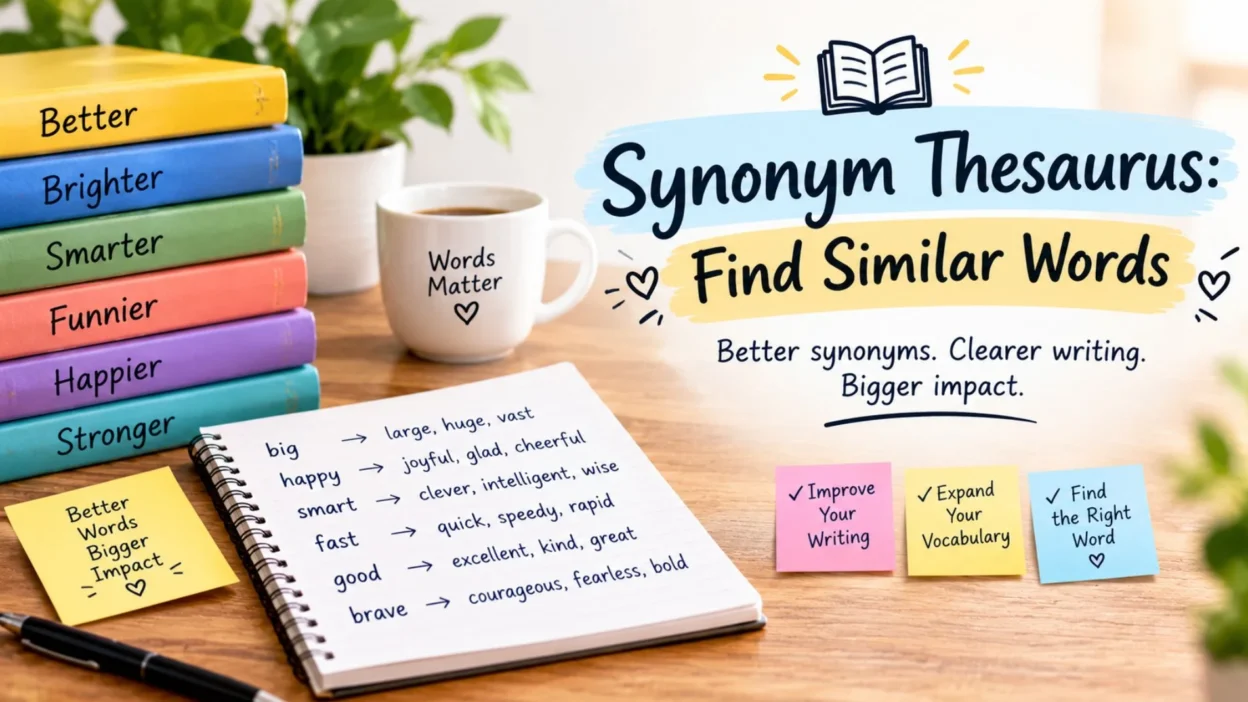
For example, if you search for the word “happy,” a thesaurus may suggest:
- Joyful
- Cheerful
- Glad
- Pleased
- Delighted
- Content
These words have similar meanings, but they are not always interchangeable. Each word can express a slightly different feeling or level of emotion.
A synonym thesaurus is especially helpful when you want to avoid repetition and make your writing more natural.
What Is the Difference Between a Synonym and a Thesaurus?
A synonym and a thesaurus are related, but they do not mean the same thing.
A synonym is a word that has the same or nearly the same meaning as another word. For example, “big” and “large” are synonyms.
A thesaurus is a reference resource that provides synonyms and sometimes related words, antonyms, and different meanings.
Here is a simple comparison:
TermMeaningExampleSynonymA word with a similar meaningHappy – JoyfulThesaurusA tool for finding related wordsSearching “Happy” gives several alternativesAntonymA word with the opposite meaningHappy – Sad
In simple terms, a synonym is a type of word relationship, while a thesaurus is a tool that helps you explore those relationships.
Common Synonyms You Can Find in a Thesaurus
A thesaurus can help you discover alternatives for everyday words. Here are some useful examples.
1. Synonyms for Happy
The word “happy” describes a feeling of pleasure, satisfaction, or joy.
Common synonyms include:
- Joyful
- Cheerful
- Glad
- Delighted
- Pleased
- Content
- Merry
- Thrilled
- Excited
- Elated
Example: She felt delighted when she received the good news.
2. Synonyms for Important
“Important” describes something valuable, meaningful, or significant.
Common alternatives include:
- Significant
- Essential
- Valuable
- Crucial
- Major
- Meaningful
- Vital
- Necessary
- Relevant
- Critical
Example: Education plays an essential role in personal development.
3. Synonyms for Good
The word “good” can describe something positive, useful, enjoyable, or of high quality.
Common synonyms include:
- Excellent
- Great
- Wonderful
- Positive
- Fine
- Outstanding
- Superb
- Beneficial
- Pleasant
- Remarkable
Example: She did an excellent job on her school project.
4. Synonyms for Beautiful
“Beautiful” describes something attractive, lovely, or pleasing to the eye.
Common synonyms include:
- Gorgeous
- Lovely
- Attractive
- Stunning
- Pretty
- Elegant
- Charming
- Graceful
- Exquisite
- Breathtaking
Example: The garden looked breathtaking in the morning sunlight.
5. Synonyms for Big
“Big” refers to something large in size, amount, or importance.
Common alternatives include:
- Large
- Huge
- Enormous
- Massive
- Giant
- Immense
- Vast
- Grand
- Substantial
- Tremendous
Example: They live in a large house near the city center.
How Does a Synonym Thesaurus Work?
A synonym thesaurus organizes words according to their meanings and relationships. When you search for a word, it provides a list of similar terms.
For example, searching for “smart” may show words such as intelligent, clever, bright, brilliant, and knowledgeable.
Most online thesaurus tools allow users to search quickly without checking a printed dictionary.
Here is how to use one:
- Enter a word: Type the word you want to replace or understand.
- Explore alternatives: Review the list of suggested synonyms.
- Check the meanings: Understand the small differences between the suggested words.
- Read examples: Look at how each word is used in a sentence.
- Choose the right option: Select the word that fits your sentence and writing style.
Using these steps can help you improve your vocabulary and communicate more effectively.
Benefits of Using a Synonym Thesaurus
A synonym thesaurus offers several benefits for students, writers, professionals, and English learners.
1. Improves Vocabulary
Exploring alternative words introduces you to new vocabulary. Over time, you become more familiar with different expressions and their meanings.
2. Reduces Word Repetition
Repeating the same word several times can make writing less interesting. A thesaurus helps you find suitable alternatives.
For example:
- Original: The movie was good. The story was good, and the acting was good.
- Improved: The movie was excellent. The story was engaging, and the acting was impressive.
3. Makes Writing More Interesting
Using appropriate synonyms can make your sentences more expressive. It also helps you communicate your ideas in a more engaging way.
4. Supports Students and Learners
Students can use a thesaurus when writing essays, completing assignments, or learning English. It helps them understand different ways to express the same idea.
5. Helps Professional Writers
Bloggers, content creators, journalists, and copywriters often need different words to make their content clear and engaging. A thesaurus can support this process.
Synonym Thesaurus vs. Dictionary
Many people confuse a thesaurus with a dictionary. Although both are useful language tools, they serve different purposes.
FeatureSynonym ThesaurusDictionaryMain purposeFinds similar wordsExplains word meaningsSynonymsProvides alternativesMay include someDefinitionsSometimes includedMain featureAntonymsMay include themSometimes includedExample sentencesOften availableCommonly availableBest useFinding alternative wordsUnderstanding a word
A dictionary helps you understand what a word means. A thesaurus helps you discover other words with similar meanings.
For the best results, you can use both tools together.
How to Choose the Right Synonym
Not every synonym works in every sentence. Words may have similar meanings but different tones, levels of formality, or uses.
Here are some tips to help you select the best option.
Understand the Context
Always consider what you are trying to communicate. For example, “slim” and “skinny” both describe someone with a thin body, but they can create different impressions.
Check the Tone
Some words sound formal, while others are more casual.
For example:
- Help – Common and simple
- Assist – More formal
- Support – Often suggests providing ongoing help
Choose a word that matches your audience and purpose.
Avoid Unnecessary Complicated Words
Using a difficult word does not automatically make writing better. Choose clear and natural language whenever possible.
Read the Complete Sentence
After replacing a word, read the entire sentence again. Make sure the new word fits naturally and keeps the original meaning.
Common Mistakes to Avoid When Using a Thesaurus
A thesaurus is helpful, but using it incorrectly can make your writing confusing.
Here are some mistakes to avoid:
- Choosing a synonym without checking its meaning: Similar words may have different meanings in certain situations.
- Using complicated vocabulary unnecessarily: Simple words are often more effective.
- Ignoring the sentence context: A word that works in one sentence may not work in another.
- Repeating synonyms too frequently: Replacing every repeated word can make writing sound unnatural.
- Forgetting the tone: A casual word may not suit a formal email or academic essay.
The best approach is to use synonyms carefully and prioritize clarity.
Who Should Use a Synonym Thesaurus?
A synonym thesaurus can be useful for almost anyone who reads, writes, or learns a language.
Students
Students can find alternative words for essays, homework, presentations, and school projects.
Bloggers and Content Writers
Content writers can discover new expressions, improve sentence variety, and make articles easier to read.
English Learners
People learning English can explore new vocabulary and understand how similar words are used.
Professionals
Professionals can use a thesaurus to improve emails, reports, presentations, and other workplace communication.
Creative Writers
Authors and poets can explore different expressions to make their stories, poems, and descriptions more engaging.
Frequently Asked Questions
What is a synonym thesaurus used for?
A synonym thesaurus is used to find words with similar or related meanings. It helps improve vocabulary, reduce repetition, and make writing clearer.
Is a thesaurus the same as a dictionary?
No. A dictionary mainly explains word meanings, pronunciation, and usage. A thesaurus focuses on synonyms and related words.
Can a thesaurus help improve English vocabulary?
Yes. It introduces learners to alternative words and helps them understand different ways to express ideas.
Are all synonyms interchangeable?
No. Some synonyms have slightly different meanings, tones, or uses. Always check the context before replacing a word.
Why should writers use a synonym thesaurus?
Writers use a thesaurus to find alternative words, avoid unnecessary repetition, and make their content more expressive.
Can I use a thesaurus for academic writing?
Yes. Students and researchers can use a thesaurus to explore suitable vocabulary. However, they should choose words carefully and maintain a clear academic tone.
What is an example of a synonym thesaurus?
For the word “beautiful,” a thesaurus may suggest lovely, gorgeous, attractive, stunning, and elegant. Each word offers a slightly different way to describe beauty.
Conclusion
A synonym thesaurus is a valuable resource for anyone who wants to improve their writing and vocabulary. It helps you discover alternative words, avoid repetition, and express ideas more clearly.
Whether you are a student, blogger, professional writer, or English learner, using a thesaurus can make everyday communication easier. However, always consider the meaning and context before choosing a synonym.
The goal is not to use complicated words but to find the most suitable words for your message.

Shehroz Ali is a digital content creator and the founder of SynonymVoro. He is passionate about vocabulary, language, writing, and creating useful online resources that make learning simple and accessible. Through SynonymVoro, he aims to help readers discover better words, improve their vocabulary, and communicate with greater clarity.