
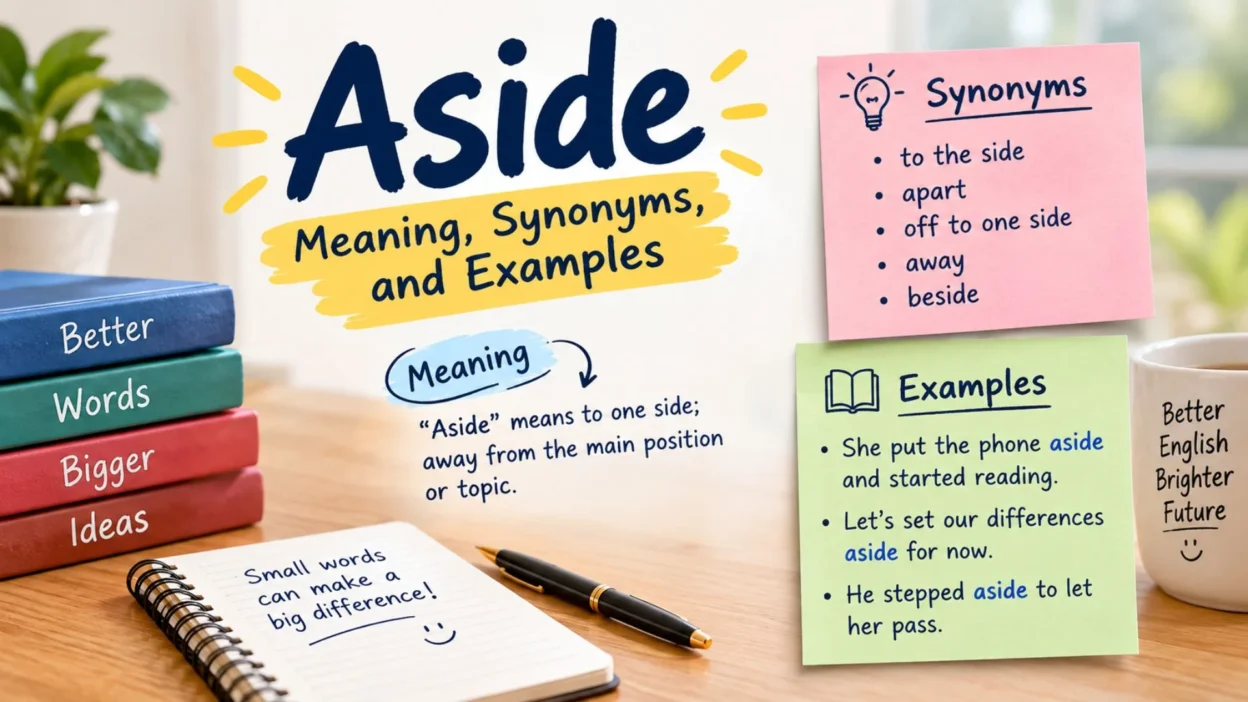
The word aside is commonly used in everyday English. It can describe moving something to one side, saving something for later, or making a comment that is separate from the main topic. However, its exact meaning depends on the sentence.
Learning how to use aside correctly can improve your vocabulary, writing, and speaking skills. In this guide, you will discover the meaning of aside, its synonyms, practical examples, common phrases, and the difference between aside and similar words.
What Does Aside Mean?
Aside can mean to one side, away from the main subject, or separately from something else. It is commonly used as an adverb and a noun.
For example:
- She moved the curtain aside.
- Please put some money aside for emergencies.
- Joking aside, we need to discuss the problem.
- The speaker added an interesting aside during the presentation.
In the first example, aside means to one side. In the second, it means saving something for later. The third example uses the word to return to a serious subject after a joke.
Therefore, understanding the surrounding words is important when interpreting this term.
Simple Definition of Aside
In simple English, aside means moving something away from its usual position, keeping something separate, or making a comment that is not part of the main discussion.
Here are three easy ways to understand it:
- To one side: Move something away from the center.
- Keep for later: Save money, time, or another resource for future use.
- Separate comment: Add a remark that is not central to the main topic.
For example, “She stepped aside to let me pass” means she moved out of the way.
Synonyms for Aside
The best synonym depends on how the word is used. Some alternatives describe physical movement, while others refer to comments or separation.
Synonyms Meaning To One Side
- Away
- Apart
- Over
- Off to the side
- To one side
- Out of the way
- Separately
- Aside from the center
Example: “He moved aside” can be rewritten as “He moved out of the way.”
Synonyms for a Side Comment
- Remark
- Comment
- Observation
- Parenthesis
- Interjection
- Digression
- Supplementary comment
- Brief observation
Example: “She made an aside during the speech” can mean “She added a brief comment during the speech.”
These words are not always interchangeable. For example, digression often describes a departure from the main subject, while remark simply means something someone says.
Examples of Aside in Sentences
Sentence examples make it easier to understand how a word works in different contexts.
- Please move aside so everyone can enter.
- He pulled the chair aside.
- She took me aside to discuss the issue privately.
- I put some money aside for my education.
- The teacher set aside extra time for questions.
- Jokes aside, this is an important matter.
- The author included a funny aside in the story.
- He pushed the box aside to reach the door.
- We should set our differences aside and work together.
- Apart from one small mistake, the report was excellent.
Notice that the last example uses apart from, not aside. The expressions can have related meanings in some contexts, but they are not identical.
Common Phrases With Aside
The word appears in several common English expressions. Learning these phrases can help you use it naturally.
Put Aside
Meaning: To save something for later or move it away.
Examples:
- I put aside some money every month.
- Please put aside the documents until tomorrow.
- She put aside her phone to focus on studying.
Set Aside
Meaning: To reserve something for a particular purpose or stop considering something temporarily.
Examples:
- We set aside time for revision.
- The family set aside money for a holiday.
- Let us set aside our disagreements for now.
Move Aside
Meaning: To move away from a position so someone or something can pass.
Examples:
- Please move aside for the ambulance.
- He moved aside to let his friend sit down.
- The crowd moved aside when the bus arrived.
Take Someone Aside
Meaning: To speak privately with someone away from other people.
Examples:
- The manager took the employee aside for a quick conversation.
- My teacher took me aside to explain the mistake.
- She took her friend aside to offer some advice.
Joking Aside
Meaning: Used to return to a serious point after making a joke.
Examples:
- Joking aside, we need to finish this project.
- Joking aside, your advice was helpful.
- Joking aside, the situation needs attention.
Aside From
Meaning: Except for something, or apart from it.
Examples:
- Aside from the weather, the trip was wonderful.
- Aside from English, he also studies French.
- Aside from a few errors, the essay was well written.
The phrase can express an exception or introduce something additional, depending on the context.
Aside as a Noun
Although aside is frequently used as an adverb, it can also be a noun. As a noun, it often refers to a comment that is separate from the main conversation, speech, or story.
For example:
- The actor made a humorous aside.
- Her aside made the audience laugh.
- The writer included several asides in the chapter.
- His quiet aside was not heard by everyone.
In theatre, an aside can be a remark spoken by a character that is intended for the audience rather than the other characters.
The plural form is asides.
Aside as an Adverb
An adverb can describe an action, and aside often explains the direction or manner of movement.
Examples:
- She stepped aside.
- He pushed the curtain aside.
- The child moved aside to make room.
- Please stand aside for a moment.
In these sentences, the word describes movement away from a position or out of someone’s path.
It can also appear in expressions about saving or separating something:
- He set aside a few hours for reading.
- They put aside their concerns temporarily.
Aside vs. Besides
Aside and besides look similar, but they are used differently.
WordMeaningExampleAsideTo one side or separate from the main subjectMove aside, please.BesidesIn addition to or apart fromBesides English, she studies Spanish.Aside fromExcept for, or apart fromAside from the delay, everything went well.
Use aside when talking about movement, setting something apart, or making a side comment. Use besides when adding another point or referring to something in addition to what has already been mentioned.
For example:
- Correct: Besides tea, we also serve coffee.
- Correct: Please move aside.
- Correct: Aside from the cost, the product is excellent.
Remember that aside from is a separate expression with its own meaning. The best choice depends on the sentence.
Aside vs. Apart
Both words can suggest separation, but they are not always interchangeable.
Aside often describes movement to one side or something being kept separate. Apart commonly describes two or more things that are separated from each other.
Examples:
- Move aside so I can pass.
- The two houses are far apart.
- She put her work aside.
- Keep the books apart from the wet papers.
The expression apart from can also mean “except for” or “in addition to,” depending on context.
Aside vs. Away
The words aside and away can both describe movement, but they usually emphasize different ideas.
- Aside: Movement to one side or out of the way.
- Away: Movement farther from a person, place, or thing.
Examples:
- She moved aside to let me enter.
- He walked away from the building.
- Put the chair aside for a moment.
- Keep the children away from the hot stove.
Use aside when the idea of moving to one side is important. Use away when the focus is on distance or moving farther from something.
Common Mistakes When Using Aside
Even though aside is a short word, it can be confusing in certain expressions.
Using Aside Instead of Besides
Incorrect: Aside English, he speaks French.
Correct: Besides English, he speaks French.
Use besides to add another item or idea in this sentence.
Confusing Aside With Apart
Incorrect: The two friends stood aside from each other, meaning they were physically separated by a distance.
Better: The two friends stood apart from each other.
Use apart when emphasizing the distance between two people or objects.
Forgetting the Phrase Aside From
Incorrect: Aside the traffic, the journey was easy.
Correct: Aside from the traffic, the journey was easy.
In this example, aside from introduces an exception.
Using an Unnatural Synonym
Not every synonym works in every sentence. For instance, replacing move aside with move apart may change the meaning.
Choose a synonym that preserves the original sentence’s meaning and sounds natural in context.
How to Use Aside in Everyday English
You can use aside in conversations, emails, school assignments, and professional writing.
Here are some practical examples:
- At work: Let’s set aside 15 minutes to discuss the report.
- At school: The teacher took the student aside to explain the instructions.
- At home: Put the clean clothes aside for tomorrow.
- In conversation: Joking aside, I appreciate your help.
- In writing: The author added a brief aside to explain the background.
The phrase you choose should match your intended meaning. For example, use set aside when reserving time and take someone aside when having a private conversation.
Quick Tips to Remember the Meaning
Use these simple reminders to learn the word more easily:
- Think of move aside when someone needs space.
- Think of put aside when saving something for later.
- Think of take someone aside when speaking privately.
- Think of joking aside when returning to a serious topic.
- Think of aside from when expressing an exception.
- Think of a side comment when using aside as a noun.
Practising these phrases in your own sentences can help you remember them.
Frequently Asked Questions
What does aside mean in simple words?
Aside usually means to one side, separately, or away from the main subject. It can also refer to a brief comment that is not part of the main discussion.
What are the best synonyms for aside?
Depending on the context, possible alternatives include to one side, away, apart, remark, comment, and observation. Not all of these words can replace aside in every sentence.
What does aside from mean?
Aside from can mean “except for” or “apart from.” For example, “Aside from the rain, we enjoyed the trip.”
What is the difference between aside and besides?
Aside commonly describes movement, separation, or a side comment. Besides usually means “in addition to.” For example, “Move aside” describes movement, while “Besides math, I study science” adds another subject.
Is aside an adverb or a noun?
It can be both. As an adverb, it appears in sentences such as “She stepped aside.” As a noun, it can refer to a side comment, as in “The speaker made an aside.”
Conclusion
The word aside has several useful meanings in English. It can describe moving to one side, saving something for later, speaking privately, or adding a comment outside the main subject. Expressions such as put aside, set aside, joking aside, and aside from are especially common.
Learning the difference between aside, besides, apart, and away will help you choose the right word for each situation. Review the examples in this guide and practise using the expressions in everyday sentences to strengthen your vocabulary.

Shehroz Ali is a digital content creator and the founder of SynonymVoro. He is passionate about vocabulary, language, writing, and creating useful online resources that make learning simple and accessible. Through SynonymVoro, he aims to help readers discover better words, improve their vocabulary, and communicate with greater clarity.