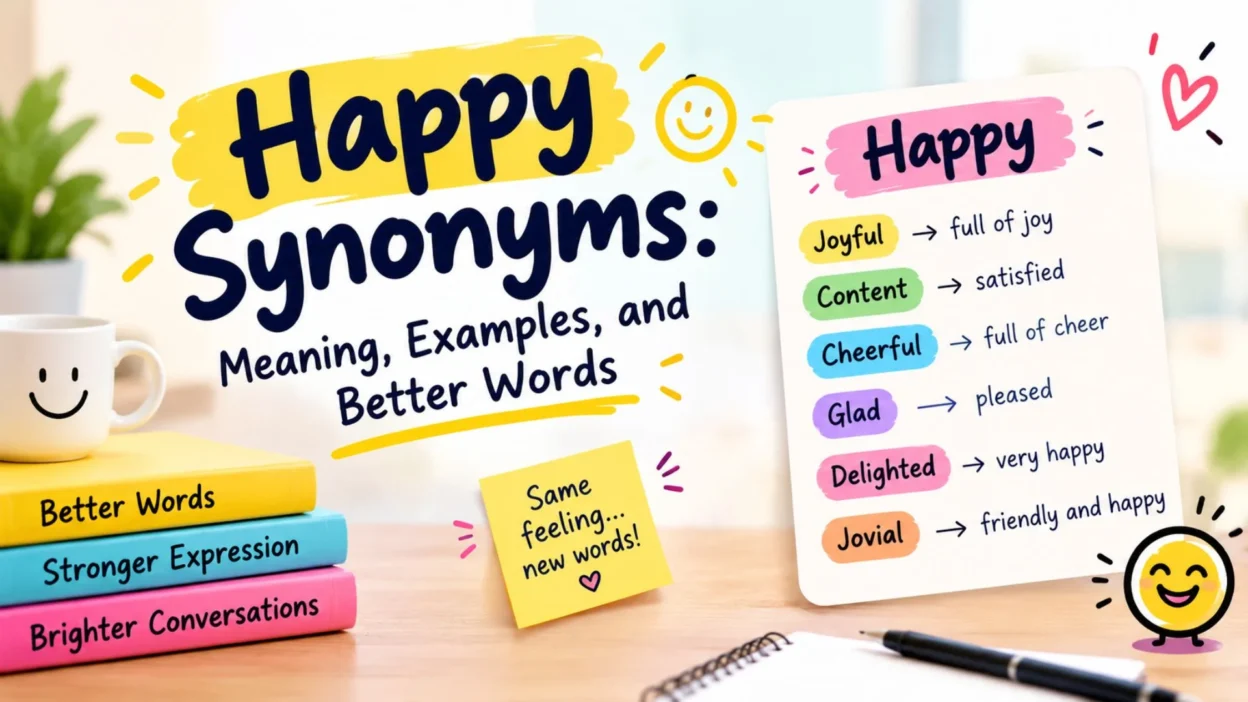
Looking for the best happy synonyms to express joy, excitement, satisfaction, or contentment? The English language offers many alternatives to the word happy. Each one communicates a slightly different feeling, so choosing the right word can make your writing clearer and more expressive.
For example, you might feel delighted when receiving wonderful news, content when enjoying a peaceful evening, or ecstatic after achieving a major goal. Although these words describe positive emotions, they are not interchangeable in every situation. Some express intense excitement, while others suggest quiet satisfaction or a cheerful personality.
Learning different words for happy can improve your vocabulary, strengthen your essays, and make everyday conversations more interesting. It can also help you avoid repeating the same adjective in emails, stories, social media captions, and professional documents.
This guide explores more than 100 alternatives to happy, explains their meanings, and provides practical examples. You will also discover formal and informal expressions, useful phrases, common mistakes, and tips for selecting the most appropriate synonym for your sentence.
What Does Happy Mean?
The word happy is an adjective that describes a feeling of pleasure, joy, or satisfaction. People often use it when something good happens or when they feel comfortable with their circumstances.
For example:
- Maya felt happy after receiving encouraging news.
- The children were happy during their family picnic.
- I am happy with the results of my project.
However, happy has more than one meaning. It can describe an emotional state, a person’s general mood, or a willingness to do something.
Consider the sentence, “I would be happy to help.” Here, happy means willing or pleased to offer assistance rather than experiencing intense joy.
Similarly, the phrase “a happy coincidence” describes an unexpected event that produces a favorable result.
Understanding these different meanings helps you choose synonyms that fit the context instead of replacing happy with a word that changes the original message.
100+ Happy Synonyms With Meanings
The following alternatives cover different levels of happiness, from mild pleasure to overwhelming excitement. Some describe temporary feelings, while others suggest a person’s usual attitude or a lasting sense of satisfaction.
Common Synonyms for Happy
These familiar words work well in everyday conversations, school assignments, and general writing.
SynonymMeaningExample sentenceGladFeeling pleased about somethingI am glad you came to the meeting.PleasedFeeling satisfaction or approvalShe was pleased with her final grade.CheerfulShowing a positive, lively moodOur cheerful neighbor greeted everyone.JoyfulFeeling or expressing great joyThe joyful family celebrated together.DelightedExtremely pleased by somethingWe were delighted to receive your invitation.ContentSatisfied with your situationHe felt content with his quiet life.SatisfiedFeeling that expectations have been metThe customer was satisfied with the service.MerryCheerful and full of enjoymentEveryone enjoyed a merry holiday gathering.JollyHappy, friendly, and good-humoredOur jolly host kept the conversation lively.UpbeatPositive and optimisticShe remained upbeat despite the delay.BrightCheerful or full of promiseHis bright smile lifted the mood.PleasantGiving a feeling of enjoymentWe had a pleasant afternoon outdoors.BlissfulExperiencing deep happiness or peaceThey spent a blissful weekend together.ContentedFeeling comfortable and satisfiedThe contented puppy slept beside its owner.LightheartedFree from serious worryTheir lighthearted conversation eased the tension.
Strong Synonyms for Very Happy
Sometimes happy does not fully express the intensity of an emotion. These alternatives are useful when someone experiences exciting news, a major achievement, or a memorable celebration.
SynonymMeaningExample sentenceEcstaticOverwhelmed with happinessLiam was ecstatic about winning the competition.ElatedExtremely happy and excitedShe felt elated after passing her exams.OverjoyedFilled with great joyWe were overjoyed to see our relatives again.ThrilledExtremely pleased and excitedI was thrilled to receive the scholarship.EuphoricExperiencing intense happiness or excitementThe team felt euphoric after its victory.ExhilaratedFeeling excited and energizedHe felt exhilarated after finishing the race.ExultantShowing triumphant happinessThe exultant players celebrated their success.JubilantExpressing great happiness after a successJubilant supporters cheered outside the stadium.EnrapturedFilled with intense delightThe audience was enraptured by the performance.RapturousExpressing overwhelming pleasure or enthusiasmThe singer received a rapturous welcome.GleefulShowing obvious delightThe gleeful children opened their presents.ExuberantFull of lively energy and enthusiasmHer exuberant greeting surprised everyone.Over the moonExtremely happy; informalHe was over the moon about his promotion.On cloud nineFeeling exceptionally happy; informalThey were on cloud nine after their engagement.Walking on airFeeling light and extremely happyShe was walking on air after the interview.
Synonyms for Calm Happiness and Satisfaction
Happiness does not always involve excitement or celebration. Sometimes, it means feeling peaceful, comfortable, or satisfied with what you have.
SynonymMeaningExample sentenceAt easeComfortable and free from tensionI felt at ease among my new colleagues.FulfilledExperiencing satisfaction from meaningful activitiesShe felt fulfilled by her volunteer work.SereneCalm and peacefulHe enjoyed a serene morning by the lake.TranquilFree from disturbance or agitationThey found a tranquil spot in the garden.PeacefulExperiencing calm and freedom from conflictThe family enjoyed a peaceful evening.ComfortableFeeling relaxed or satisfied with circumstancesShe was comfortable with her decision.GratifiedFeeling pleasure because something has been achievedThe teacher felt gratified by her students’ progress.AppreciativeRecognizing something with gratitudeHe felt appreciative of his friends’ support.ThankfulFeeling or expressing gratitudeWe were thankful for the unexpected kindness.GratefulFeeling appreciation for help or good fortuneI am grateful for your encouragement.UntroubledFree from worry or distressShe looked untroubled during the journey.CarefreeFree from everyday worriesThey enjoyed a carefree afternoon at the beach.
Important distinction: Content, fulfilled, and peaceful do not always mean the same thing as happy. Content describes satisfaction, fulfilled suggests a sense of purpose, and peaceful emphasizes calmness. Choose the word that best expresses the feeling you intend to communicate.
Synonyms for a Cheerful Personality
Some words describe how a person usually behaves rather than how they feel at a particular moment.
SynonymMeaningExample sentenceSunnyNaturally cheerful and positiveHer sunny personality made visitors feel welcome.BuoyantOptimistic and able to recover quicklyHe stayed buoyant after the disappointing result.VivaciousLively, energetic, and animatedThe vivacious presenter captured everyone’s attention.SpiritedEnergetic and full of enthusiasmThe spirited group welcomed new members.GenialFriendly and pleasantOur genial guide answered every question.AmiableFriendly and easy to get along withThe amiable receptionist greeted each guest.Good-humoredCheerful and not easily annoyedHis good-humored response made everyone laugh.ChirpyCheerful and lively; informalShe sounded chirpy on the phone.PerkyEnergetic and livelyThe perky assistant welcomed customers.UpbeatConsistently positive in attitudeHis upbeat outlook encouraged the team.
Informal and Slang Expressions for Happy
Casual expressions can make messages, conversations, and social media posts sound more natural. However, some are unsuitable for formal essays or business correspondence.
ExpressionMeaningExample sentenceStokedVery excited or pleasedI’m stoked about the upcoming trip.ChuffedVery pleased; common in British EnglishShe was chuffed with her results.Tickled pinkExtremely pleased or amusedGrandma was tickled pink by the surprise.PumpedExcited and enthusiasticWe’re pumped for the final match.BuzzingExcited and full of energy; informalHe was buzzing after the concert.PsychedExcited and mentally preparedI’m psyched about starting my new course.On top of the worldFeeling exceptionally successful or happyShe felt on top of the world after graduation.In seventh heavenExperiencing great happinessThe newlyweds were in seventh heaven.Happy as a clamVery content or comfortableThe children were happy as clams at the park.Grinning from ear to earSmiling broadly because of happinessHe was grinning from ear to ear after the announcement.
These expressions are especially useful for informal storytelling. For instance, “I’m delighted to announce my appointment” sounds professional, while “I’m absolutely stoked about my new job” sounds more casual.
Formal Synonyms for Happy
Professional writing often benefits from precise words rather than exaggerated expressions. The best choice depends on whether you want to communicate satisfaction, appreciation, excitement, or willingness.
SynonymBest useExample sentencePleasedProfessional approval or satisfactionWe are pleased with the proposed solution.DelightedWarm, positive professional communicationI am delighted to accept your invitation.GratifiedSatisfaction after an achievementThe department was gratified by the positive feedback.SatisfiedConfirmation that requirements are metThe client was satisfied with the final report.ContentAcceptance of a situationThe board was content with the revised proposal.AppreciativeAcknowledging value or assistanceWe are appreciative of your continued support.WillingReadiness to do somethingI am willing to discuss the alternatives.GladFriendly, straightforward professional languageI am glad we could resolve the issue.
In business emails, “I would be happy to assist” is also a natural and professional expression. In this context, happy communicates willingness rather than intense emotion.
Best Synonyms for Happy in Different Situations
Choosing the right word becomes easier when you consider the situation, the intensity of the emotion, and the tone of your writing.
Happy Synonyms for Everyday Conversations
Use familiar expressions when speaking with friends, family members, or colleagues.
Good choices include:
- Glad
- Pleased
- Cheerful
- Thrilled
- Delighted
- Content
- Excited
Examples:
- “I’m glad you called.”
- “She was thrilled to see her old friends.”
- “We’re delighted that you could join us.”
These expressions communicate positive feelings without making ordinary situations sound overly dramatic.
Happy Synonyms for Academic Writing
In essays and assignments, precise vocabulary matters more than using complicated words. Select a synonym that accurately describes the situation.
For example:
- Use satisfied when discussing whether a requirement has been met.
- Use pleased when describing a positive reaction.
- Use content when explaining a person’s satisfaction with their circumstances.
- Use elated when an event produces intense excitement.
- Use fulfilled when discussing meaning or purpose.
Instead of writing, “The students were happy with their progress,” you could write, “The students were pleased with their progress.”
However, do not replace every instance of happy. Repetition is sometimes preferable to a synonym that changes the meaning.
Happy Synonyms for Professional Emails
Professional communication usually benefits from polite, clear language.
Consider these alternatives:
- “I am pleased to confirm your appointment.”
- “We are delighted to welcome you to the team.”
- “I would be happy to provide further information.”
- “I am glad we could reach an agreement.”
- “We appreciate your support.”
For example, delighted works well for a positive announcement, whereas happy to help communicates willingness. Matching the expression to your purpose makes your message sound natural.
Happy Synonyms for Creative Writing
Stories and descriptive passages benefit from words that communicate emotion through actions, expressions, and context.
Try these examples:
- Radiant: Her radiant expression revealed her excitement.
- Jubilant: Jubilant fans filled the streets after the victory.
- Blissful: They enjoyed a blissful afternoon in the countryside.
- Gleeful: A gleeful laugh escaped when the surprise was revealed.
- Lighthearted: Their lighthearted exchange brought relief after a difficult day.
Creative writers can also show happiness without naming the emotion directly. A character who dances across the room, smiles uncontrollably, or embraces a friend may communicate joy more vividly than a sentence that simply says they are happy.
Happy Synonyms by Level of Intensity
Not all positive emotions have the same intensity. The following guide helps you choose an expression that matches the situation.
LevelSuggested wordsTypical situationMild pleasureGlad, pleasedReceiving a kind messageQuiet satisfactionContent, satisfiedCompleting a manageable taskGeneral cheerfulnessCheerful, upbeatEnjoying an ordinary dayStrong happinessDelighted, thrilledReceiving exciting newsIntense joyElated, overjoyedAchieving an important goalExtreme excitementEcstatic, euphoricCelebrating a major personal milestoneLasting satisfactionFulfilled, contentedFinding meaning in meaningful work
This table is a practical guide rather than a strict ranking. For example, a person may feel deeply content without experiencing the excitement associated with being thrilled.
Other Ways to Say “I Am Happy”
The phrase “I am happy” is useful, but you can make your message more specific by describing the reason for your emotion.
Here are some alternatives:
Original phraseAlternativeBest contextI am happy to see you.I’m delighted to see you.Warm greetingI am happy about the news.I’m thrilled about the news.Exciting announcementI am happy with my results.I’m pleased with my results.Academic or professional achievementI am happy with my life.I feel content with my life.Personal satisfactionI am happy for you.I’m genuinely delighted for you.Congratulating someoneI am happy to help.I’d be glad to help.Offering assistanceI am very happy.I’m overjoyed.Intense happinessI am happy today.I’m in a cheerful mood today.Everyday conversationI am happy with this decision.I’m satisfied with this decision.Evaluating a choiceI am happy about the opportunity.I’m excited about the opportunity.Future plans
The key is to communicate the exact reason for your happiness. As a result, your writing becomes more descriptive without requiring unnecessarily complicated vocabulary.
Synonyms for Happy in Specific Phrases
Some expressions containing happy have their own meanings. Therefore, replacing the word without considering the entire phrase can produce an unnatural sentence.
Happy Birthday
For birthday wishes, you can use expressions such as:
- Wishing you a joyful birthday.
- Have a wonderful birthday.
- Wishing you a delightful celebration.
- May your special day be filled with joy.
- Sending you warm wishes for a fantastic birthday.
These alternatives work well for greeting cards, text messages, and social media captions.
Happy to Help
When happy means willing to assist, suitable alternatives include:
- Glad to help
- Willing to assist
- Pleased to help
- Ready to help
- Happy to support you
For example, “I would be glad to review your document” sounds natural in a professional email.
Happy With Something
When happy means satisfied with a result, use expressions such as:
- Satisfied with
- Pleased with
- Content with
- Comfortable with
- Delighted with
For example, “The team was satisfied with the revised schedule” communicates approval more precisely than “The team was happy.”
Happy Accident
A happy accident is an unexpected event that produces a useful or pleasant outcome.
Depending on the context, alternatives include:
- Fortunate coincidence
- Lucky discovery
- Unexpected benefit
- Pleasant surprise
For instance, “A fortunate coincidence helped us discover a simpler solution” conveys the idea without relying on the original expression.
Common Mistakes When Using Happy Synonyms
Using synonyms improves vocabulary only when the replacement preserves the intended meaning. Several common mistakes can make sentences sound awkward or misleading.
1. Using Strong Words for Mild Feelings
Ecstatic and euphoric express intense happiness. They may sound exaggerated when describing an ordinary event.
Instead of saying, “I was ecstatic to receive a routine reminder,” consider “I was glad to receive the reminder.”
Reserve stronger words for situations that genuinely justify them.
2. Confusing Contentment With Excitement
Content describes satisfaction, while thrilled communicates excitement. Although both are positive feelings, they express different emotional experiences.
For example, “She felt content in her new home” suggests comfort and satisfaction. By contrast, “She was thrilled to move into her new home” emphasizes excitement about the move.
3. Choosing Informal Expressions for Formal Writing
Expressions such as stoked, pumped, and tickled pink are suitable for casual conversations. However, they may sound out of place in a formal report or academic essay.
Choose pleased, satisfied, or delighted when a more professional tone is appropriate.
4. Replacing Happy With an Unrelated Positive Word
Not every positive adjective is a true synonym for happy.
For example, fortunate describes good luck, while successful describes achieving a desired result. Neither automatically means that someone feels happy.
A person can be successful without feeling satisfied. Similarly, someone can be fortunate without experiencing excitement.
Always check the meaning of the replacement before using it.
5. Repeating Synonyms Without Considering Context
Using delighted, thrilled, ecstatic, and overjoyed in every paragraph can make writing repetitive, even when the words are technically appropriate.
Instead, describe different aspects of the situation. You might explain that someone felt pleased with the result, relieved that the work was finished, and proud of the achievement.
This approach creates more meaningful descriptions and avoids unnecessary synonym repetition.
How to Choose the Right Synonym for Happy
Follow these practical steps when selecting an alternative.
Step 1: Identify the feeling. Determine whether you mean joy, excitement, satisfaction, calmness, or willingness.
Step 2: Consider the intensity. Use glad for mild pleasure, delighted for strong enjoyment, and ecstatic for overwhelming happiness.
Step 3: Match the tone. Formal emails generally benefit from pleased or delighted, while casual conversations may suit stoked or over the moon.
Step 4: Read the complete sentence. Check whether the replacement preserves the original meaning and sounds natural.
Step 5: Avoid unnecessary complexity. A simple word is often the best choice. If happy communicates your meaning clearly, there is no need to replace it.
For example, “I am happy to help” is already natural and polite. Changing it to “I am euphoric to provide assistance” would make the sentence sound strange because euphoric does not express ordinary willingness appropriately.
Antonyms of Happy
Antonyms are words with opposite or contrasting meanings. Learning them alongside synonyms can help expand your vocabulary and improve comprehension.
AntonymMeaningExample sentenceSadFeeling sorrowHe felt sad when the visit ended.UnhappyNot feeling happyShe was unhappy with the arrangement.MiserableExtremely unhappy or uncomfortableThey felt miserable during the long delay.GloomySad or lacking optimismThe gloomy weather affected his mood.DisappointedFeeling let down by an outcomeWe were disappointed by the cancellation.UpsetEmotionally distressedShe was upset about the misunderstanding.MelancholyExperiencing thoughtful or lasting sadnessA melancholy mood settled over the room.DejectedFeeling low after a setbackHe looked dejected after losing the match.DissatisfiedNot content with somethingCustomers were dissatisfied with the service.DiscouragedLosing confidence or hopeShe felt discouraged after the rejection.
The best antonym depends on the original meaning. For example, dissatisfied is a useful opposite of satisfied, while dejected may better describe someone who feels low after a disappointment.
Frequently Asked Questions
1. What are the best synonyms for happy?
Some of the most useful alternatives are glad, pleased, cheerful, joyful, delighted, content, thrilled, and overjoyed. The best choice depends on the situation and the intensity of the feeling.
2. What is a stronger word for happy?
Ecstatic, elated, overjoyed, and euphoric express intense happiness. Thrilled and delighted are also strong choices when describing excitement about good news or a special event.
3. What is a formal synonym for happy?
Pleased, satisfied, gratified, and delighted work well in professional or formal writing. For example, “We are pleased with the outcome” communicates satisfaction clearly and politely.
4. What is another word for happy in a sentence?
The best alternative depends on the sentence. You could replace “I am happy to see you” with “I am delighted to see you” or “I am glad to see you.”
5. What is the difference between happy and content?
Happy is a broad term for pleasure, joy, or satisfaction. Content usually describes a settled feeling of satisfaction with a situation. Someone can feel content without being especially excited.
6. What is a synonym for very happy?
Overjoyed, ecstatic, elated, thrilled, and euphoric are common choices. However, ecstatic and euphoric generally suggest more intense feelings than glad or pleased.
7. What are some informal ways to say happy?
Informal alternatives include stoked, chuffed, pumped, buzzing, tickled pink, and on cloud nine. Their suitability varies by region and context, so use them where a conversational tone feels natural.
8. Is excited a synonym for happy?
Excited can be a suitable alternative when happiness includes anticipation or enthusiasm. However, excitement can also involve nervousness or uncertainty, so it does not always mean the same thing as happiness.
Conclusion
Learning happy synonyms gives you more ways to express joy, excitement, satisfaction, and contentment. Words such as glad, pleased, and cheerful work well in everyday situations, while delighted, thrilled, and ecstatic communicate stronger emotions. Meanwhile, content, fulfilled, and peaceful describe different forms of satisfaction or calmness.
The most effective synonym is not necessarily the longest or most impressive word. Instead, choose the expression that matches your intended meaning, audience, and tone. With practice, you can make your essays, professional emails, conversations, and creative writing more precise and engaging.
Explore different alternatives, study their example sentences, and pay attention to how each word changes the meaning of a sentence. A thoughtful vocabulary choice can make even a simple message more expressive.

Shehroz Ali is a digital content creator and the founder of SynonymVoro. He is passionate about vocabulary, language, writing, and creating useful online resources that make learning simple and accessible. Through SynonymVoro, he aims to help readers discover better words, improve their vocabulary, and communicate with greater clarity.