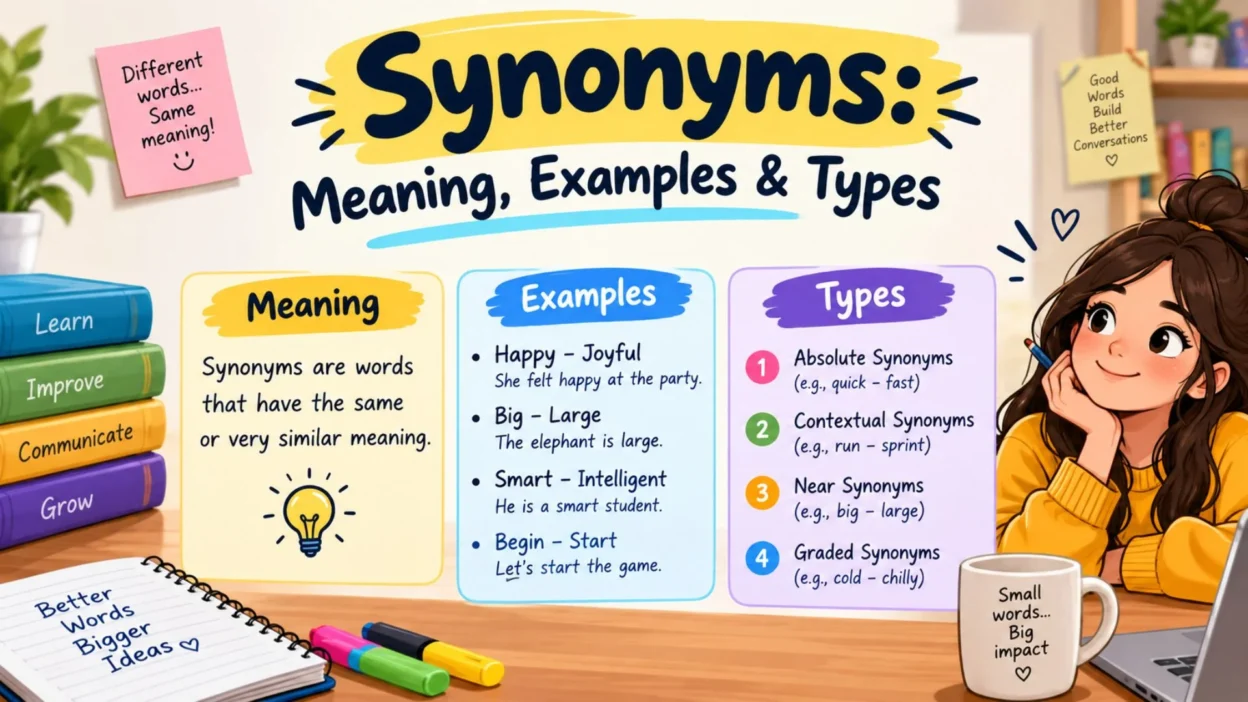
Synonyms are words that have the same or nearly the same meaning as other words. They help you express ideas clearly, improve your vocabulary, and make your writing more interesting. For example, happy and joyful have similar meanings, while big and large can describe something of considerable size.
Learning synonyms is useful for students, teachers, writers, professionals, and anyone who wants to communicate more effectively in English. Instead of repeating the same word several times, you can choose another word that fits the sentence and expresses your intended meaning.
However, synonyms are not always interchangeable. Some words sound more formal, while others are better suited to casual conversations. Similarly, two words may have related meanings but work differently depending on the context.
This guide explains what synonyms mean, explores common types, provides practical examples, and shows you how to choose the right word for different situations. You will also learn how synonyms differ from antonyms and how to use a thesaurus to build a stronger vocabulary.
What Are Synonyms?
A synonym is a word or phrase that has the same or nearly the same meaning as another word or phrase. Synonyms allow people to express similar ideas using different words.
For example, smart and intelligent describe someone who understands things or learns quickly. Likewise, begin and start can describe the action of doing something for the first time.
Here are some common examples:
WordSynonymsHappyJoyful, cheerful, delightedSadUnhappy, sorrowful, upsetBigLarge, huge, enormousSmallLittle, tiny, miniatureFastQuick, rapid, speedyBeautifulLovely, attractive, gorgeousEasySimple, effortless, straightforwardDifficultHard, challenging, demandingSmartIntelligent, clever, brightHelpAssist, support, aid
These words share similar meanings, but their exact usage can differ. For instance, enormous usually suggests a greater size than big, while delighted often expresses stronger happiness than pleased.
Therefore, choosing a synonym requires more than finding a word with a similar definition. You should also consider the sentence, tone, and meaning you want to communicate.
Why Are Synonyms Important?
Synonyms play an important role in everyday communication, education, and professional writing. They help you express ideas with greater variety while maintaining clarity.
1. They Improve Vocabulary
Learning synonyms introduces you to new words and helps you understand how English works. For example, knowing glad, pleased, cheerful, and delighted gives you several ways to describe positive feelings.
As you learn these words, you also develop a better understanding of their differences.
2. They Reduce Unnecessary Repetition
Repeating the same word too often can make a paragraph feel monotonous. Synonyms offer alternatives when another word genuinely fits the meaning.
For example:
Repetitive: The movie was funny. The funny movie made everyone laugh because it was funny.
Improved: The movie was hilarious. Its clever jokes made everyone laugh.
The revised version communicates the same general idea more naturally.
3. They Make Writing More Precise
Sometimes, a synonym describes an idea more accurately than a general word.
For example, walk is a broad term. However, stroll suggests walking in a relaxed way, while march often suggests walking with firm, regular steps.
Choosing a more precise word helps readers picture the action more clearly.
4. They Support English Language Learning
Students can use synonyms to understand unfamiliar vocabulary, prepare for exams, and improve reading comprehension.
For example, if you understand the word purchase, you may recognize that it has a similar meaning to buy. This connection can help you understand sentences in books, lessons, and everyday conversations.
5. They Improve Professional Communication
Synonyms can help you adjust your language to suit different audiences.
For instance, ask works well in everyday conversation, while inquire may sound more formal in certain professional situations.
Nevertheless, simple language is often the clearest choice. A more complicated word is not automatically better.
Types of Synonyms
Synonyms can be grouped according to how closely their meanings match and how they are used. Understanding these differences helps you select suitable words instead of replacing terms without considering their meaning.
1. Absolute Synonyms
Absolute synonyms have exactly the same meaning and can be substituted for one another in all relevant contexts without changing the meaning.
However, truly interchangeable synonyms are uncommon in everyday language. Many words that appear identical have differences in usage, grammar, or context.
For this reason, it is usually safer to check how a word is used rather than assume that two terms are identical.
2. Near-Synonyms
Near-synonyms have similar meanings but are not interchangeable in every situation.
For example, thin, slim, and skinny all describe a small body size. However, slim often has a positive or neutral tone, while skinny can sound critical depending on the context.
Similarly, cheap and inexpensive both refer to a low price. Yet cheap can also suggest poor quality, whereas inexpensive generally focuses on cost.
Near-synonyms are common, so context matters whenever you choose between similar words.
3. Contextual Synonyms
Contextual synonyms have similar meanings in a particular sentence or situation.
For example:
- Please start the meeting.
- Please begin the meeting.
In this context, start and begin communicate essentially the same instruction.
However, a word may have several meanings, and its alternatives depend on which meaning is intended. For instance, bright can describe strong light, an intelligent person, or a vivid color. Each meaning requires different synonyms.
4. Formal and Informal Synonyms
Some words express similar ideas but suit different levels of formality.
Informal wordMore formal alternativeAskInquireBuyPurchaseHelpAssistGetObtainNeedRequireTellInformStartCommenceEndConclude
The appropriate choice depends on the audience and purpose. In a friendly message, help may sound more natural than assist. In a formal report, either word may work depending on the sentence.
5. Regional Synonyms
English varies between countries and regions. Different words may refer to the same object or concept in different varieties of English.
For example, apartment is common in American English, while flat is widely used in British English.
Similarly, vacation is common in American English, whereas holiday is frequently used in British English for time away from work or school.
These differences are useful to understand when writing for an international audience.
Common Synonyms With Examples
The following lists provide useful vocabulary for everyday communication, school assignments, and professional writing.
Synonyms for Happy
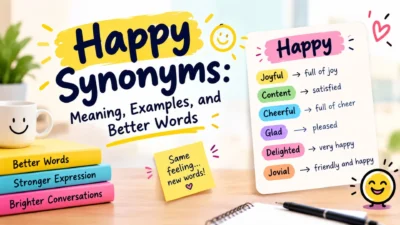
Words related to happiness include:
- Joyful
- Cheerful
- Glad
- Pleased
- Delighted
- Content
- Thrilled
- Elated
Example: She felt delighted when she received the good news.
Delighted communicates stronger happiness than a simple pleased in many contexts.
Synonyms for Sad
Common alternatives for sad include:
- Unhappy
- Upset
- Sorrowful
- Miserable
- Gloomy
- Disappointed
- Heartbroken
- Dejected
Example: He felt disappointed when the event was canceled.
Although these words relate to sadness, they describe different experiences. Heartbroken usually expresses deep emotional pain, while disappointed often describes unhappiness caused by an unmet expectation.
Synonyms for Good
Useful alternatives include:
- Excellent
- Great
- Fine
- Positive
- Beneficial
- Effective
- Wonderful
- Valuable
Example: Regular practice is beneficial for improving writing skills.
The word beneficial is more specific than good because it emphasizes a helpful result.
Synonyms for Bad
Depending on the context, you can use:
- Poor
- Harmful
- Unpleasant
- Negative
- Unsatisfactory
- Unfavorable
- Inferior
- Damaging
Example: Poor planning caused delays in the project.
Choose harmful when something causes damage, unsatisfactory when something fails to meet expectations, and unpleasant when describing an uncomfortable experience.
Synonyms for Important
Common alternatives include:
- Essential
- Significant
- Crucial
- Vital
- Major
- Meaningful
- Noteworthy
- Relevant
Example: Clear instructions are essential for completing the task correctly.
Essential suggests something is necessary, while significant often emphasizes importance or impact.
Synonyms for Beautiful
Words with similar meanings include:
- Lovely
- Attractive
- Gorgeous
- Stunning
- Elegant
- Charming
- Appealing
- Exquisite
Example: The garden looked stunning in the morning sunlight.
Some words emphasize visual appearance, while others suggest elegance, charm, or exceptional beauty.
Synonyms for Fast
Useful alternatives include:
- Quick
- Rapid
- Speedy
- Swift
- Brisk
- Expeditious
Example: The team developed a quick solution to the problem.
Rapid often describes a process or change, while swift can emphasize speed and smoothness of movement.
Synonyms for Difficult
Consider these alternatives:
- Hard
- Challenging
- Complicated
- Demanding
- Arduous
- Complex
- Troublesome
Example: The assignment was challenging, but the students completed it successfully.
Complex usually refers to something with many connected parts, whereas demanding emphasizes the effort required.
Synonyms for Different Parts of Speech
Synonyms can belong to different parts of speech, including nouns, verbs, adjectives, and adverbs. Recognizing the grammatical role of a word helps you replace it correctly.
Noun Synonyms
Nouns identify people, places, objects, or ideas.
WordSynonymsJobOccupation, position, roleIdeaThought, concept, notionGiftPresent, offeringMistakeError, faultGoalAim, objective, targetStoryTale, narrative
Example: Her main goal is to improve her English vocabulary.
You could replace goal with objective in this sentence without changing the main idea significantly.
Verb Synonyms
Verbs describe actions, events, or states.
WordSynonymsSpeakTalk, converseMakeCreate, produceShowDisplay, demonstrateChooseSelect, pickExplainClarify, describeImproveEnhance, develop
Example: The teacher explained the lesson clearly.
In some contexts, clarified would work as an alternative. However, demonstrated would be more suitable if the teacher showed how something worked.
Adjective Synonyms
Adjectives describe nouns and pronouns.
WordSynonymsCleverSmart, intelligentKindCaring, considerateCalmPeaceful, composedHonestTruthful, sincereStrongPowerful, sturdyTiredExhausted, weary
Example: The considerate student helped a classmate understand the instructions.
Here, considerate describes someone who thinks about other people’s needs.
Adverb Synonyms
Adverbs can describe how, when, where, or to what extent something happens.
WordSynonymsQuicklyRapidly, swiftlyCarefullyCautiously, attentivelyQuietlySilently, softlyClearlyPlainly, distinctlyHappilyCheerfully, gladly
Example: She carefully checked the report before submitting it.
The word attentively may work in a similar context, but it emphasizes paying close attention rather than simply avoiding mistakes.
Synonyms vs. Antonyms
Synonyms and antonyms are related vocabulary concepts, but they serve different purposes.
A synonym has the same or a similar meaning as another word. An antonym expresses an opposite meaning.
FeatureSynonymsAntonymsMeaningSame or similarOppositePurposeAdd variety or precisionShow contrastExample 1Happy, joyfulHappy, sadExample 2Begin, startBegin, finishExample 3Strong, powerfulStrong, weakExample 4Easy, simpleEasy, difficult
For example, the words large and huge are synonyms because they describe similar sizes. By contrast, large and small are antonyms because they express opposite sizes.
Both types of words help readers understand relationships between ideas. Synonyms expand vocabulary, while antonyms make comparisons and contrasts easier to express.
How to Use Synonyms Correctly
Finding a similar word is only the first step. You must also ensure that it fits the meaning, grammar, and tone of your sentence.
1. Understand the Original Meaning
Before replacing a word, identify what it means in that particular sentence.
For example, light can refer to brightness, low weight, or a pale color. The best synonym changes according to the intended meaning.
- A light bag: a lightweight bag.
- A light room: a bright room.
- A light blue shirt: a pale blue shirt.
These examples show why context is essential.
2. Check the Tone
Consider whether you are writing a formal email, a school assignment, a blog post, or a casual message.
For example, purchase may suit a formal report, while buy often sounds more natural in everyday conversation.
Neither word is automatically better. The right choice depends on your audience.
3. Check Grammar and Sentence Structure
Synonyms do not always follow the same grammatical patterns.
For example:
- She listened to the teacher.
- She heard the teacher.
Both sentences involve sound, but they do not mean exactly the same thing. Listen to generally suggests paying attention, while hear refers to perceiving sound.
Therefore, check the entire sentence before making a substitution.
4. Avoid Replacing Every Repeated Word
Repetition is not always a problem. In fact, repeating a key term can make technical explanations easier to understand.
For example, a scientific article may need to use the same technical term consistently. Replacing it with a loosely related word could confuse readers.
Instead, vary your vocabulary only when the alternative improves clarity or flow.
5. Read the Revised Sentence
After choosing a synonym, read the sentence aloud or review it carefully.
Ask yourself whether the revised sentence sounds natural and preserves the intended meaning. If it sounds awkward, the original word may be the better choice.
How to Find Synonyms Using a Thesaurus
A thesaurus is a reference tool that lists synonyms and often includes antonyms or related terms. It can be a printed book, a website, or a feature in a writing application.
Here is a simple process for using one effectively.
Step 1: Identify the word. Find the word you want to replace, such as important.
Step 2: Search for alternatives. Look up the word in a trusted dictionary or thesaurus.
Step 3: Compare the definitions. Review options such as crucial, essential, and significant.
Step 4: Check example sentences. See how each alternative works in real contexts. A dictionary with usage examples can help you understand differences between similar terms.
Step 5: Select the best fit. Choose the word that matches your sentence, audience, and intended meaning.
Step 6: Review your writing. Make sure the new word sounds natural and does not change your message.
Useful online resources include the Cambridge English Thesaurus and Thesaurus.com. Both can help you explore alternatives and improve your vocabulary.
Common Mistakes to Avoid When Using Synonyms
Even experienced writers can choose unsuitable alternatives. Avoiding these mistakes will help you communicate more clearly.
Assuming Every Synonym Has Exactly the Same Meaning
Words with similar definitions may have different levels of intensity or emotional associations. For example, annoyed usually expresses less intense anger than furious.
How to avoid it: Compare definitions and examine example sentences before choosing an alternative.
Using Unnecessarily Complicated Words
A sophisticated word does not automatically make writing stronger. Replacing help with facilitate may make a sentence less direct when the simpler word works perfectly well.
How to avoid it: Prefer the clearest word that communicates your intended meaning.
Ignoring Formality
Some words are more suitable for professional or academic situations than others. Slang may sound natural in a conversation but inappropriate in a formal report.
How to avoid it: Match your vocabulary to your audience and purpose.
Changing the Meaning of a Sentence
A synonym may introduce a different implication. For example, confident and arrogant both relate to how someone presents themselves, but they communicate different judgments.
How to avoid it: Check the connotations of a word before replacing the original term.
Using a Thesaurus Without Checking Context
A thesaurus may list words that are related but not suitable for every use of the original word.
How to avoid it: Use a dictionary to confirm the definition and grammar of the alternative.
Frequently Asked Questions
What is the simple meaning of synonyms?
Synonyms are words or phrases with the same or nearly the same meaning. For example, small and little are synonyms in many contexts.
What are five examples of synonyms?
Five common pairs are happy and joyful, big and large, quick and fast, begin and start, and smart and intelligent.
What is the difference between synonyms and antonyms?
Synonyms have similar meanings, while antonyms have opposite meanings. For example, beautiful and lovely are synonyms, whereas beautiful and ugly are antonyms.
Can synonyms always replace each other?
No. Similar words can differ in meaning, tone, intensity, grammar, and context. Always check whether the replacement preserves the original message.
How can I learn synonyms easily?
Read regularly, learn words in sentences, keep a vocabulary notebook, and practice using new words in your own writing. A thesaurus can also help you discover alternatives and compare their meanings.
What is a thesaurus used for?
A thesaurus helps users find synonyms, antonyms, and related words. Writers and students use it to explore vocabulary and choose words that suit their intended meaning.
Why are synonyms useful in writing?
Synonyms help writers reduce unnecessary repetition, express ideas more precisely, and adjust their tone for different audiences. However, clarity should always take priority over variety.
What is the best way to choose a synonym?
Start by understanding the original word, then compare possible alternatives. Consider context, grammar, tone, and meaning before selecting the most appropriate option.
Conclusion
Synonyms are an essential part of English vocabulary. They help you communicate ideas in different ways, reduce unnecessary repetition, and choose words that express your meaning more precisely.
However, similar words are not always interchangeable. Their meanings, tones, and grammatical uses can differ depending on the situation. Therefore, it is important to understand the context before making a substitution.
To improve your vocabulary, practice learning synonyms in complete sentences rather than memorizing isolated word lists. Use a reliable dictionary or thesaurus when necessary, and choose clarity over complicated language. With regular practice, you can become a more confident reader, writer, and communicator.

Shehroz Ali is a digital content creator and the founder of SynonymVoro. He is passionate about vocabulary, language, writing, and creating useful online resources that make learning simple and accessible. Through SynonymVoro, he aims to help readers discover better words, improve their vocabulary, and communicate with greater clarity.