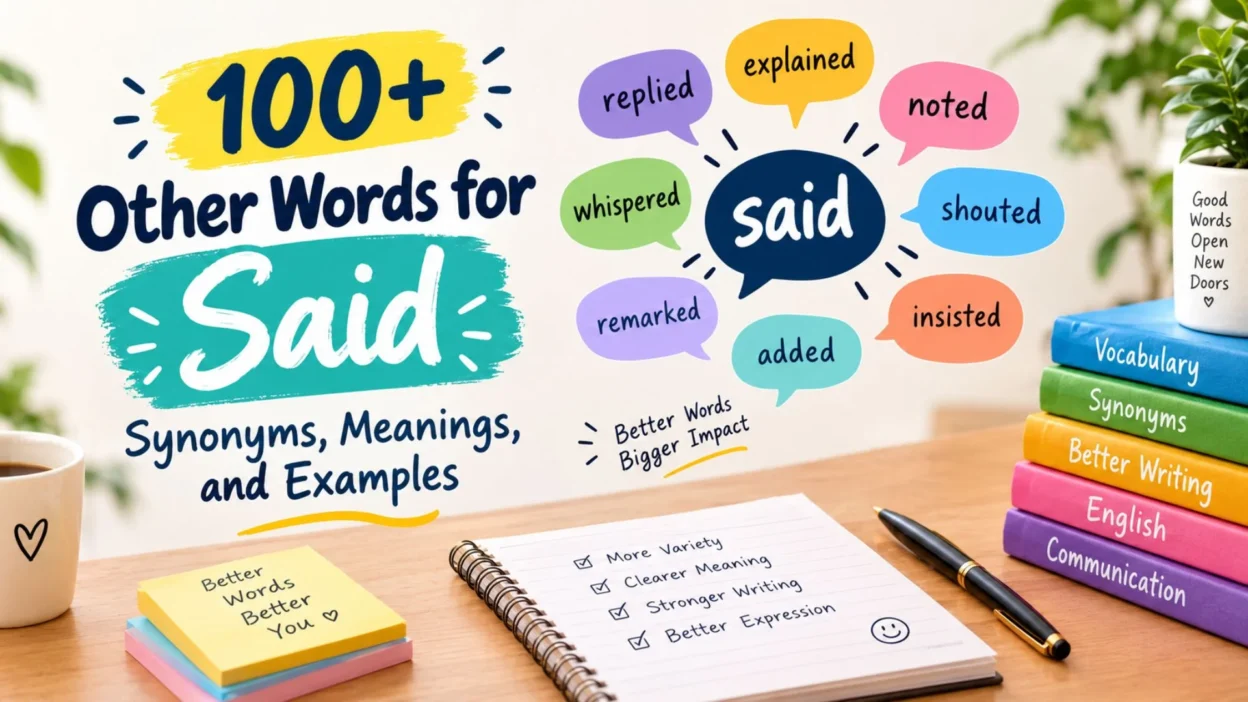
The word “said” is one of the most common words in English. We use it in conversations, stories, essays, emails, and everyday writing. However, repeating “said” too often can make an article or story feel dull. Using the right synonyms for said can make your writing clearer, more expressive, and more interesting.
Whether you are writing a school assignment, a short story, a blog post, or a professional email, there are many other words for said that can help you express ideas more effectively. Some words show excitement, while others express anger, sadness, curiosity, or uncertainty.
In this guide, you will discover more than 100 synonyms for said, organized by tone and purpose. Each word includes a simple meaning and an example sentence to help you understand when to use it.
What Does “Said” Mean?
“Said” is the past tense of the verb “say.” It means that someone expressed something through words.
For example:
- Sarah said she would arrive early.
- Tom said that he enjoyed the book.
- My teacher said the assignment was due on Friday.
The word works well in most situations. You do not need to replace it every time it appears. However, choosing a more specific verb can help readers understand how someone speaks or feels.
For example, compare these sentences:
- “I am so happy!” Emma said.
- “I am so happy!” Emma exclaimed.
The second sentence adds excitement to the dialogue. That is why learning different words for said can improve your writing.
Common Synonyms for Said
If you want a simple replacement for “said,” start with these everyday alternatives. They work in many types of writing, although their meanings are not always identical.
SynonymMeaningExampleStatedExpressed something clearlyHe stated his opinion.ToldGave information to someoneShe told me the truth.RepliedAnswered someone“Not today,” he replied.AnsweredResponded to a questionMia answered the teacher.RemarkedMade a comment“That is interesting,” he remarked.MentionedReferred to something brieflyShe mentioned the meeting.ExplainedMade something easier to understandHe explained the rules.AddedIncluded more information“We should leave early,” she added.NotedPointed something outThe manager noted the delay.CommentedExpressed an opinionHe commented on the design.ObservedShared something noticedShe observed that the room was quiet.ReportedGave information about an eventThey reported the incident.DeclaredAnnounced something firmlyHe declared his support.ExpressedCommunicated a thought or feelingShe expressed her concerns.InformedGave someone informationThe office informed us of the change.
These words are useful when you want variety without making your writing sound unnatural. Choose the word that best matches the meaning of the sentence.
Other Words for Said in Dialogue
Dialogue helps readers understand characters and follow a story. The right dialogue tag can also show whether a character is answering, interrupting, or sharing information.
Here are useful alternatives for dialogue:
- Replied: “I will be there,” she replied.
- Responded: “That makes sense,” he responded.
- Answered: “The library closes at six,” she answered.
- Added: “We also need some paper,” he added.
- Continued: “After that, we went home,” she continued.
- Interrupted: “Wait a minute,” he interrupted.
- Whispered: “Keep this a secret,” she whispered.
- Murmured: “I am not sure,” he murmured.
- Asked: “Can you help me?” she asked.
- Suggested: “We could try again,” he suggested.
- Explained: “The train leaves at noon,” she explained.
- Reminded: “Do not forget your keys,” he reminded her.
- Admitted: “I made a mistake,” she admitted.
- Insisted: “I really did see it,” he insisted.
- Agreed: “That sounds fair,” she agreed.
Remember that some of these verbs describe a specific action. For example, “asked” introduces a question, while “whispered” describes a quiet voice. Use them when the context supports their meaning.
Synonyms for Said That Show Happiness or Excitement
When a character feels excited, proud, or delighted, a stronger verb can help communicate that emotion.
WordMeaningExampleExclaimedSpoke with strong emotion“We won!” she exclaimed.CheeredExpressed happiness or support“You did it!” he cheered.CelebratedExpressed joy about success“We passed!” they celebrated.BeamedSpoke or reacted with happiness“I got the job,” she beamed.GushedSpoke with great enthusiasm“This place is wonderful!” she gushed.RejoicedExpressed great happiness“Our team succeeded!” he rejoiced.EnthusedSpoke with excitement“The idea is fantastic,” she enthused.BoastedSpoke proudly about an achievement“I finished first,” he boasted.PraisedExpressed approval“You did excellent work,” she praised him.CelebratedMarked a happy event“This is our best day,” they celebrated.
Some words, such as “boasted,” can suggest arrogance. Others, such as “gushed,” may sound informal. Choose a word that fits both the character and the situation.
Other Words for Said That Show Anger
Angry dialogue often needs a more forceful verb. These words can help readers recognize frustration, irritation, or disagreement.
- Snapped: “Leave me alone!” she snapped.
- Shouted: “Stop right there!” he shouted.
- Yelled: “I cannot hear you!” she yelled.
- Growled: “Do not touch that,” he growled.
- Barked: “Get back in line!” the coach barked.
- Raged: “This is completely unfair!” he raged.
- Screeched: “You forgot again!” she screeched.
- Scolded: “You should have been more careful,” he scolded.
- Complained: “The room is too cold,” she complained.
- Protested: “I did not agree to this,” he protested.
- Retorted: “You are wrong about that,” she retorted.
- Demanded: “Tell me what happened,” she demanded.
- Argued: “That is not the right solution,” he argued.
- Grumbled: “I have to do everything myself,” he grumbled.
- Warned: “Be careful near the edge,” she warned.
These words are not interchangeable. “Shouted” describes a loud voice, while “demanded” shows that someone is firmly requesting something. “Retorted” usually suggests a sharp or quick reply.
Synonyms for Said That Show Sadness
When writing an emotional scene, you may want a word that conveys sorrow, disappointment, or regret.
- Murmured: “I wish things were different,” she murmured.
- Whimpered: “Please do not leave,” the child whimpered.
- Sobbed: “I cannot believe it,” she sobbed.
- Cried: “I miss my friends,” he cried.
- Mourned: “We will always remember him,” they mourned.
- Lamented: “We lost a wonderful opportunity,” she lamented.
- Sighed: “It was a difficult day,” he sighed.
- Confessed: “I have been feeling lonely,” she confessed.
- Admitted: “I should have listened,” he admitted.
- Regretted: “I wish I had made another choice,” she said regretfully.
Words such as “sobbed” and “whimpered” describe emotional or vocal actions rather than simply reporting speech. Use them only when the scene supports that description.
Other Words for Said That Show Confidence
Confident characters often speak directly and firmly. The following words can help express certainty, authority, or determination.
WordExampleAsserted“We have enough evidence,” she asserted.Declared“I will accept the challenge,” he declared.Insisted“I know what I saw,” she insisted.Emphasized“Safety must come first,” he emphasized.Affirmed“Your decision is correct,” she affirmed.Confirmed“The appointment is tomorrow,” he confirmed.Proclaimed“Today marks a new beginning,” she proclaimed.Maintained“I still believe this is right,” he maintained.Guaranteed“I will finish the work,” she guaranteed.Vowed“I will keep my promise,” he vowed.
Use these verbs carefully. For example, “confirmed” works when someone verifies information, while “vowed” suggests a serious promise.
Other Words for Said in Academic and Professional Writing
In essays, research papers, reports, and workplace communication, precise language is more important than dramatic language. These alternatives can help you explain ideas and present information clearly.
- Indicated: The results indicated a clear improvement.
- Suggested: The evidence suggested another explanation.
- Demonstrated: The experiment demonstrated the effect.
- Argued: The author argued that education should be accessible.
- Proposed: The researcher proposed a new approach.
- Concluded: The report concluded that further study was needed.
- Claimed: The witness claimed that the event happened earlier.
- Asserted: The speaker asserted that the plan was practical.
- Acknowledged: The manager acknowledged the team’s efforts.
- Emphasized: The report emphasized the importance of training.
- Highlighted: The study highlighted several key issues.
- Established: The research established a connection between the factors.
- Recommended: The committee recommended additional testing.
- Revealed: The survey revealed a change in public opinion.
- Illustrated: The example illustrated the main point.
In academic writing, make sure the verb accurately represents the source. For instance, “proved” is stronger than “suggested,” so do not use it unless the evidence genuinely supports that level of certainty.
Other Words for Said When Asking Questions
When someone asks a question, the dialogue tag can show whether the person is curious, confused, or looking for information.
- Inquired: “Is there a train at seven?” she inquired.
- Questioned: “Are you sure about that?” he questioned.
- Wondered: “Why is the door open?” she wondered.
- Queried: “Could you explain this point?” he queried.
- Asked: “Where did you put the book?” she asked.
- Probed: “What happened after the meeting?” the reporter probed.
- Pressed: “Can you give me a clear answer?” she pressed.
- Interrogated: “Where were you last night?” the detective interrogated him.
- Challenged: “How can you support that claim?” he challenged.
- Clarified: “Do you mean next Monday?” she clarified.
Some verbs imply more than a simple question. “Probed” suggests looking for deeper information, while “interrogated” often suggests formal or intense questioning.
Other Words for Said That Show Uncertainty
Sometimes characters hesitate, doubt something, or struggle to express their thoughts. These words can help communicate that feeling.
- Hesitated: “I am not sure,” she hesitated.
- Stammered: “I-I did not know,” he stammered.
- Stuttered: “Can we talk later?” she stuttered.
- Muttered: “Maybe it will work,” he muttered.
- Speculated: “Perhaps the weather will improve,” she speculated.
- Guessed: “I think it is the right road,” he guessed.
- Wondered: “Could this be the answer?” she wondered.
- Doubted: “I am not convinced,” he said doubtfully.
- Suggested: “Maybe we should wait,” she suggested.
- Mumbled: “I forgot my notebook,” he mumbled.
Remember that hesitation can be shown through actions as well as dialogue tags. For example, “She paused before answering” can sound more natural than using an unusual synonym.
Tips for Choosing the Right Synonym for Said
Finding another word for said is easy. Choosing the right one takes a little more care. Follow these tips to keep your writing clear and natural.
1. Match the Emotion
Think about what the speaker feels. Use “exclaimed” for excitement, “snapped” for irritation, and “murmured” for quiet speech. The word should fit the scene.
2. Consider the Volume
Words such as “whispered,” “shouted,” and “yelled” describe how loudly someone speaks. Choose the one that matches the character’s voice.
3. Keep Your Writing Natural
You do not need to replace every instance of “said.” It is a simple, useful word that rarely distracts readers. Too many unusual dialogue tags can make a story feel forced.
4. Use Precise Verbs in Professional Writing
For reports and essays, choose words such as “stated,” “indicated,” “explained,” or “concluded” when they accurately describe the source’s meaning.
5. Avoid Changing the Meaning
“Claimed,” “admitted,” and “confessed” carry different implications. A person who claims something is not necessarily admitting a mistake. Always consider the context.
6. Use Actions to Add Variety
Instead of adding a dialogue tag to every sentence, show a character’s reaction.
For example:
“Are you coming?” Maya asked.
Daniel checked his watch. “Give me five minutes.”
This approach makes dialogue easier to follow without relying on a long list of synonyms.
Frequently Asked Questions
What is the best synonym for said?
“Stated,” “remarked,” “replied,” and “mentioned” are useful alternatives. The best choice depends on the sentence and the meaning you want to convey.
What are formal words for said?
Formal alternatives include “stated,” “indicated,” “asserted,” “declared,” “reported,” and “explained.” In academic writing, choose the word that accurately represents the speaker’s message.
What are some creative words for said in a story?
For creative writing, you can use “whispered,” “murmured,” “exclaimed,” “snapped,” “insisted,” and “confessed.” These words can add tone and emotion when used appropriately.
What words can replace said in dialogue?
Common dialogue alternatives include “replied,” “answered,” “asked,” “remarked,” “added,” and “continued.” For emotional dialogue, words such as “shouted” or “whispered” may be more suitable.
Is it bad to use the word said too often?
Not necessarily. “Said” is a natural dialogue tag that readers usually notice very little. Repetition can become distracting, but replacing it with an unusual word in every sentence may be even more distracting.
What is another word for said in an essay?
For essays, useful alternatives include “stated,” “argued,” “suggested,” “explained,” “claimed,” and “concluded.” Choose according to whether the writer presents an opinion, explains an idea, or reaches a conclusion.
What is a synonym for said that shows anger?
“Snapped,” “shouted,” “growled,” “retorted,” and “demanded” can communicate anger or frustration. Each has a slightly different meaning, so choose one that fits the scene.
Conclusion
Learning other words for said can help you become a more confident writer. From simple alternatives such as “stated” and “replied” to expressive verbs such as “exclaimed,” “whispered,” and “insisted,” each option offers a different way to communicate meaning.
The key is to choose words that fit the situation. Use expressive verbs in stories and dialogue, and prefer precise language in essays, reports, and professional writing. You can also keep using “said” when it is the clearest choice.
With practice, you will learn when to use a synonym and when a simple dialogue tag works best. This balance will make your writing easier to read, more natural, and more engaging.

Shehroz Ali is a digital content creator and the founder of SynonymVoro. He is passionate about vocabulary, language, writing, and creating useful online resources that make learning simple and accessible. Through SynonymVoro, he aims to help readers discover better words, improve their vocabulary, and communicate with greater clarity.