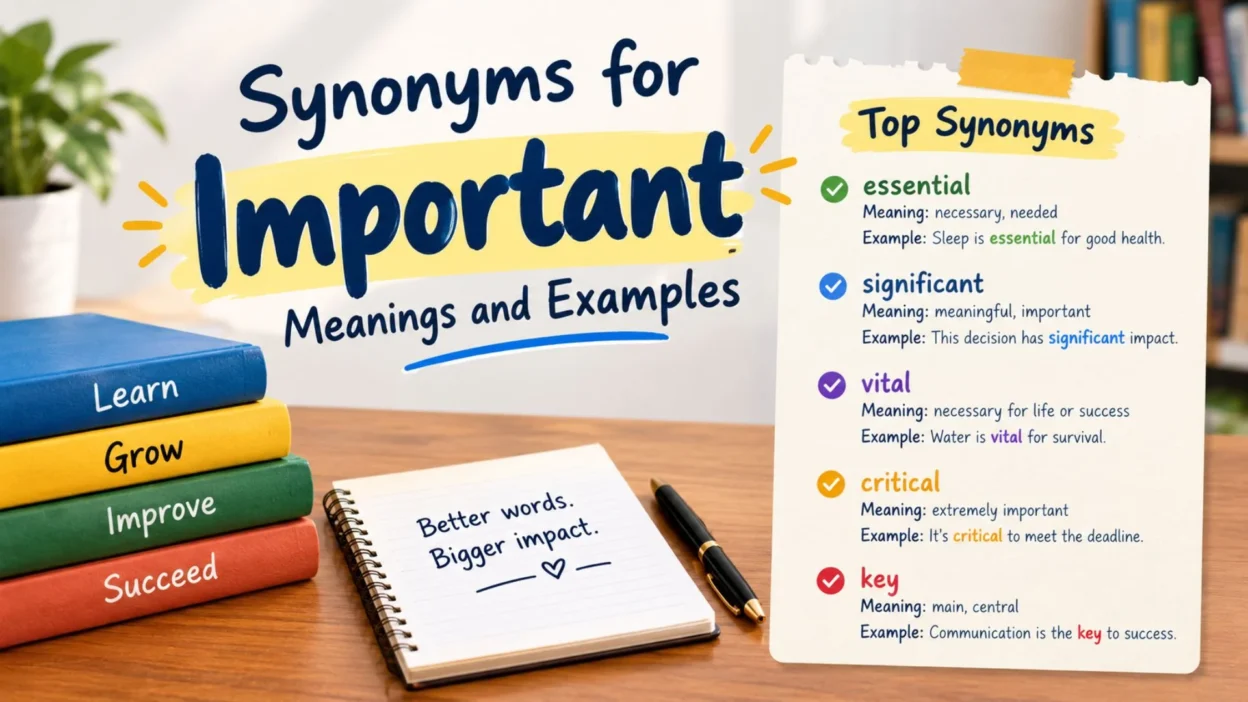
The word important is commonly used in everyday conversations, school assignments, emails, and professional writing. However, repeating the same word too often can make your writing sound less interesting. Learning synonyms for important helps you express ideas more clearly and choose words that fit different situations.
For example, you might describe an important meeting as a crucial meeting, an important discovery as a significant discovery, or an important skill as an essential skill. Although these words have similar meanings, each one carries a slightly different emphasis.
In this guide, you will discover more than 50 synonyms for important, along with simple definitions, example sentences, and tips for choosing the right word.
What Does Important Mean?
The word important is an adjective that describes something that has considerable value, meaning, influence, or effect. It can refer to a person, event, decision, idea, task, or piece of information.
For example:
- Education is important for personal growth.
- Please attend the important meeting tomorrow.
- Regular exercise plays an important role in maintaining good health.
The best synonym depends on what you want to emphasize. Some alternatives highlight necessity, while others focus on influence, value, or meaning.
Common Synonyms for Important
Here are some of the most useful synonyms for important and their meanings.
SynonymMeaningExample SentenceEssentialAbsolutely necessaryWater is essential for life.SignificantMeaningful or influentialThe study revealed a significant change.CrucialExtremely important to successCommunication is crucial for teamwork.VitalNecessary for life or successTrust is vital in a relationship.CriticalExtremely important or requiring careful attentionWe must solve this critical problem.MajorGreat in size, importance, or effectThe company announced a major change.KeyEspecially important to a resultPlanning is a key part of the project.ValuableWorthwhile or usefulHer advice was valuable to the team.FundamentalForming the basic foundationReading is a fundamental skill.NecessaryNeeded for a particular purposeIdentification is necessary for registration.RelevantClosely connected to the subjectInclude only relevant information.MeaningfulHaving significance or purposeThey had a meaningful conversation.InfluentialAble to affect people or decisionsShe is an influential community leader.ProminentWell-known or noticeableHe is a prominent researcher.NotableWorth noticing or mentioningThe project achieved notable results.
These words are useful in different contexts. For instance, essential emphasizes necessity, while influential describes the power to affect others.
Best Synonyms for Important in Different Situations
Choosing a suitable synonym makes your writing more precise. The following sections explain which words work best in common situations.
1. Essential
Meaning: Absolutely necessary or indispensable.
Use essential when something is required for a task, process, or outcome.
Examples:
- Clean water is essential for human survival.
- Good communication is essential for successful teamwork.
- A valid email address is essential for account registration.
Best for: Instructions, educational writing, professional communication, and explanations of requirements.
2. Significant
Meaning: Having considerable importance, meaning, or effect.
Use significant when something matters because of its impact, results, or meaning.
Examples:
- The company experienced significant growth.
- Her research made a significant contribution to science.
- There has been a significant improvement in student performance.
Best for: Research papers, reports, academic writing, and discussions of results.
3. Crucial
Meaning: Extremely important to the success or outcome of something.
Use crucial when a particular action, decision, or factor can strongly influence the final result.
Examples:
- Time management is crucial during examinations.
- The final interview was crucial to getting the job.
- Early preparation is crucial for a successful presentation.
Best for: Problem-solving, planning, decision-making, and academic explanations.
4. Vital
Meaning: Necessary for life, continued existence, or successful functioning.
Examples:
- Sleep is vital for overall well-being.
- Accurate information is vital to making good decisions.
- Teamwork is vital to completing the project on time.
Best for: Health-related explanations, important processes, and discussions of success.
5. Critical
Meaning: Extremely important, especially when a situation requires careful attention or action.
Examples:
- The team identified a critical error in the report.
- Critical thinking helps students evaluate information.
- The next few hours will be critical to the investigation.
Best for: Technical writing, urgent situations, analysis, and problem-solving.
6. Key
Meaning: Of central importance to understanding or achieving something.
Examples:
- Practice is a key factor in learning a language.
- Customer satisfaction is key to business growth.
- The report identifies three key findings.
Best for: Business writing, presentations, summaries, and everyday English.
7. Fundamental
Meaning: Basic and essential to a system, idea, or activity.
Examples:
- Honesty is a fundamental part of a strong relationship.
- Grammar is fundamental to understanding sentence structure.
- Equal treatment is a fundamental principle of fairness.
Best for: Education, principles, theories, and explanations of basic concepts.
8. Valuable
Meaning: Useful, worthwhile, or important because of its benefits.
Examples:
- The teacher gave us valuable feedback.
- Experience can be valuable when applying for a new job.
- The meeting provided valuable information.
Best for: Advice, skills, resources, experience, and contributions.
Formal Synonyms for Important
Formal synonyms are useful in essays, reports, business emails, presentations, and academic writing. They help you sound precise without relying on the same adjective repeatedly.
Here are some strong formal alternatives:
Formal synonymExampleSignificantThe findings represent a significant development.SubstantialThe policy produced substantial benefits.ParamountPublic safety is of paramount importance.ImperativeImmediate action is imperative.FundamentalEducation is fundamental to social progress.ConsequentialThe decision had consequential effects.NoteworthyThe report highlights a noteworthy achievement.PivotalHer research played a pivotal role in the project.IntegralTraining is an integral part of the program.IndispensableReliable data is indispensable for accurate analysis.ProminentThe issue occupies a prominent place in the debate.SalientThe report identifies the most salient concerns.
Remember that formal words are not always interchangeable. For example, paramount suggests the highest level of importance, while salient usually refers to something particularly noticeable or relevant.
Synonyms for Important in Academic Writing
Students often use important repeatedly in essays and research assignments. Choosing more precise alternatives can improve clarity and make an argument easier to understand.
Consider these examples:
- Original: Education is important for economic development.Improved: Education is essential for economic development.
- Original: The research found an important difference between the groups.Improved: The research found a significant difference between the groups.
- Original: It is important to consider both sides of the argument.Improved: It is crucial to consider both sides of the argument.
- Original: This is an important part of the theory.Improved: This is a fundamental part of the theory.
- Original: The results show an important change in behavior.Improved: The results show a notable change in behavior.
The goal is not simply to replace important with a more complicated word. Instead, choose an alternative that expresses your intended meaning accurately.
Synonyms for Important in Business and Professional Writing
Professional communication often requires language that is clear, direct, and appropriate for the situation.
Here are some examples of how to use alternatives in business writing.
Important meeting
- Key meeting
- Crucial meeting
- Significant meeting
- High-priority meeting
Example: We have a crucial meeting with the client on Monday.
Important task
- Essential task
- Priority task
- Critical task
- Key responsibility
Example: Completing the security review is a high-priority task.
Important information
- Relevant information
- Essential information
- Key details
- Significant findings
Example: Please review the key details before signing the agreement.
Important decision
- Critical decision
- Major decision
- Pivotal decision
- Significant decision
Example: The board must make a critical decision about the proposed changes.
Important role
- Key role
- Essential role
- Integral role
- Pivotal role
Example: Customer feedback plays a key role in improving our services.
Synonyms for Important in Everyday English
You do not always need formal vocabulary. Simple alternatives can make everyday conversations and messages sound more natural.
WordExample sentenceBigThis is a big day for our family.MainOur main goal is to finish the work.KeySleep is a key part of a healthy routine.SpecialThis is a special occasion for us.MeaningfulHer words were meaningful to me.ValuableYour suggestions are valuable.MajorWe made a major change to our plans.SeriousWe need to discuss a serious issue.WorthwhileLearning a new skill is worthwhile.NecessaryA password is necessary to access the account.
These alternatives suit casual conversations, text messages, personal writing, and simple explanations. However, words such as big, special, and serious communicate different ideas, so they should only replace important when the context supports that meaning.
Synonyms for Important by Meaning
One of the easiest ways to choose the right synonym is to decide what kind of importance you mean.
When something is necessary
Use:
- Essential
- Vital
- Necessary
- Indispensable
- Required
Example: Regular maintenance is necessary to keep the equipment working properly.
When something has a strong effect
Use:
- Significant
- Influential
- Consequential
- Pivotal
- Major
Example: The new policy had a significant effect on the organization.
When something deserves attention
Use:
- Notable
- Remarkable
- Prominent
- Salient
- Worthwhile
Example: The report highlights several notable achievements.
When something is central to a plan
Use:
- Key
- Core
- Fundamental
- Integral
- Principal
Example: Customer service is a core part of the company’s strategy.
When something has great value
Use:
- Valuable
- Precious
- Meaningful
- Worthwhile
- Beneficial
Example: The training provided valuable experience for new employees.
What Is the Difference Between Important, Essential, Crucial, and Significant?
These words have similar meanings, but their emphasis differs.
WordMain emphasisExampleImportantGeneral value or significanceThis is an important issue.EssentialSomething is neededWater is essential for life.CrucialSomething strongly affects the outcomeTiming is crucial to the operation.SignificantSomething has considerable meaning or impactThe study found a significant difference.VitalSomething is necessary for life or effective functioningTrust is vital to a healthy relationship.CriticalSomething requires close attention or has serious consequencesThe system has a critical error.FundamentalSomething forms the basis of a subject or systemPractice is fundamental to improvement.PivotalSomething plays a central, turning-point roleThe discovery was pivotal to the research.
For example, an important meeting may discuss several topics. A crucial meeting may determine whether a project succeeds. A significant meeting may have a lasting effect on a business or relationship.
Understanding these distinctions helps you select words that communicate your meaning more effectively.
Common Mistakes When Using Synonyms for Important
Although many words are related to important, they do not always fit the same sentence.
1. Using essential when you mean valuable
Essential suggests that something is necessary. Valuable suggests that it has worth or usefulness.
- Correct: Clean water is essential for survival.
- Correct: Her advice was valuable to the team.
2. Confusing significant with large
Significant can describe a meaningful or important effect, not merely a large physical size.
- Correct: The results showed a significant improvement.
- Less suitable: The building was significant in size.
If you mean physical size, large or substantial may be more precise.
3. Using paramount for ordinary situations
Paramount means more important than anything else in a particular context. It can sound exaggerated when describing an everyday task.
- Natural: Safety is paramount during the procedure.
- Simpler: Remembering your notebook is important.
4. Replacing every use of important
Sometimes, important is the clearest word. You do not need to replace it every time. Use synonyms when they add precision, reduce repetition, or improve the flow of your writing.
How to Choose the Best Synonym for Important
Follow these simple steps when choosing an alternative.
- Identify your meaning. Decide whether you mean necessary, valuable, influential, or significant.
- Consider your audience. Academic papers may need formal vocabulary, while everyday messages usually benefit from simple words.
- Check the sentence. Read the sentence with the replacement to make sure it still sounds natural.
- Avoid exaggeration. Do not use paramount or critical if you only mean something is generally useful.
- Use a dictionary when unsure. Check the definition and examples before using an unfamiliar word.
Choosing the right word can make your writing more accurate without making it unnecessarily complicated.
Frequently Asked Questions
What is the best synonym for important?
There is no single best synonym for every situation. Essential works when something is necessary, significant emphasizes meaning or impact, and crucial highlights something that strongly affects an outcome.
What is a formal word for important?
Formal alternatives include significant, substantial, paramount, imperative, fundamental, and pivotal. Choose the word that best matches the sentence.
What is a simple word for important?
Simple alternatives include key, main, big, and major. The best choice depends on whether you mean something is central, large in effect, or especially valuable.
What is another word for very important?
Depending on the context, you can use crucial, vital, essential, critical, or paramount. For example, “It is crucial to follow the instructions” emphasizes the importance of following them.
Can significant and important be used interchangeably?
Sometimes. Both words can describe something that matters, but significant often emphasizes meaning, impact, or a notable difference. The surrounding sentence determines whether it is the best replacement.
What is the difference between essential and necessary?
Both words describe something that is needed. Essential often emphasizes that something is fundamental or indispensable, while necessary can refer more generally to a requirement for a particular purpose.
How can I avoid repeating the word important in an essay?
Choose alternatives that match your meaning, such as essential, significant, crucial, or fundamental. You can also rewrite the sentence to explain why something matters instead of simply calling it important.
Conclusion
Learning synonyms for important can help you write more clearly, improve your vocabulary, and communicate ideas with greater precision. Words such as essential, significant, crucial, vital, and fundamental offer different ways to explain why something matters.
The key is to choose a synonym that fits the context rather than replacing important with a more complicated word automatically. With practice, you can use these alternatives naturally in essays, business emails, conversations, and everyday writing.

Shehroz Ali is a digital content creator and the founder of SynonymVoro. He is passionate about vocabulary, language, writing, and creating useful online resources that make learning simple and accessible. Through SynonymVoro, he aims to help readers discover better words, improve their vocabulary, and communicate with greater clarity.